Skip to content
Contact Us

Back to Case Studies

How RevPartners Helped Supered Scale Beyond a Partner-Led GTM Motion

No stats detected. Module will be hidden.

Customer Info

Supered is a digital adoption and sales enablement platform designed to help teams master their software (specifically CRMs like HubSpot & Salesforce) without leaving their daily workflow. The company was born from a common frustration: businesses spend thousands on CRMs, yet employees rarely follow the intended processes.

Instead of burying instructions in forgotten training videos or long PDFs, Supered embeds "superpowers" directly into the browser. It uses real-time prompts, step-by-step guides, and "Process Rules" to show reps exactly what to do next while they are working on a deal.

supered awesome


Overview

This case study covers how RevPartners helped Supered expand beyond a partner-led GTM motion and build a scalable system for reaching end users.

Supered had already seen strong success selling through the HubSpot partner ecosystem. That channel worked well, but over time, it became fully saturated. The next phase of growth meant reaching direct buyers, at a higher volume, and without adding unnecessary load to a small, full-cycle sales team.

Instead of jumping straight into outbound, Supered needed a way to identify the right accounts, understand why they were worth engaging, and give sales enough context to reach out confidently.
The Challenges


1. A Partner-Led Motion That Had Reached Its Ceiling

  • Supered’s early growth came from selling through the HubSpot partner ecosystem.
  • These were warm, relationship-driven conversations that worked well inside a defined network.
  • Over time, most of that ecosystem was already covered, leaving limited room to expand. 

2. Higher Volume, Lower Familiarity

  • Moving to an end-user motion meant reaching buyers who didn’t already know Supered.
  • Outreach now had to work harder to earn attention and start relevant conversations.
  • Volume increased, but familiarity dropped.

3. No Existing Outbound or Marketing System

  • Supered hadn’t needed outbound or demand generation before.
  • There were no systems in place for:
     
    • List building
    • Data enrichment
    • Lead or account prioritization

  • Everything that would support outbound at scale needed to be built from scratch. 

4. Limited Sales Capacity

  • Supered’s sales team consisted of full-cycle AEs handling outbound, discovery, and closing.
  • Manual prospecting (pulling lists, researching accounts, and qualifying fit) wasn’t realistic.
  • Any new motion had to respect the team’s existing workload.

5. Very Specific ICP Requirements

  • Supered only sells to companies using HubSpot or Salesforce.
  • Reaching out to the wrong accounts was wasted effort.
  • Fit needed to be confirmed before sales ever engaged.

6. Signals Without a Clear Path to Action

  • Buying signals were already happening:
     
    • Website visits
    • LinkedIn engagement
    • Hiring activity
    • Event participation

  • What was missing was a consistent way to:
     
    • Turn those signals into prioritized accounts
    • Give sales confidence in why an account was worth engaging

The Solutions


1. Moving From Static Lists to Signal-Based Sourcing

  • Supered shifted away from one-time list pulls and manual prospecting.
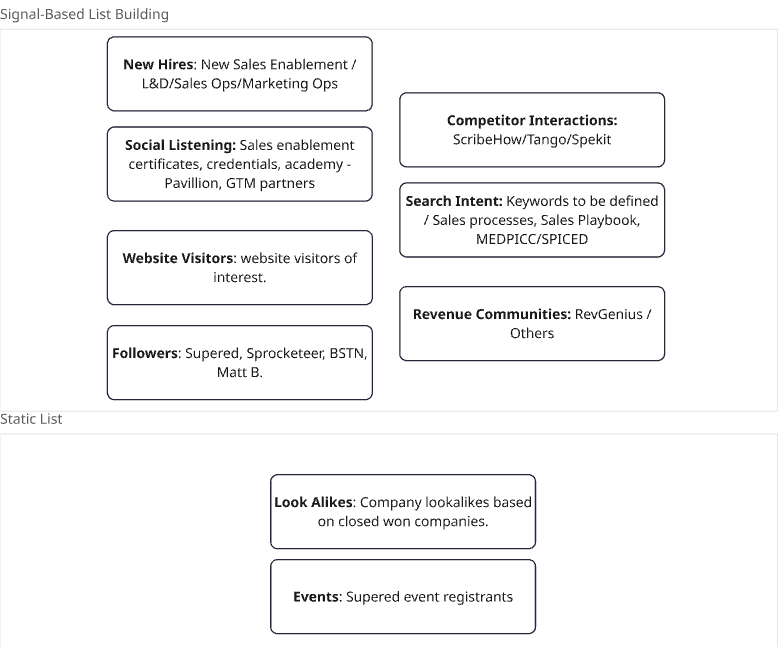
  • Instead, RevPartners built an ongoing system that sources accounts based on real activity and signals.
  • These signals include:
     
    • Website visits from companies of interest
    • New hires in sales enablement, operations, or related roles
    • Social engagement tied to specific keywords and topics
    • LinkedIn followers of Supered and key team members
    • Event registrants and lookalike accounts based on closed-won customers

Only accounts that matched Supered’s ICP and buyer criteria were allowed into HubSpot. Everything else was filtered out before sales ever saw it.

signal based list building


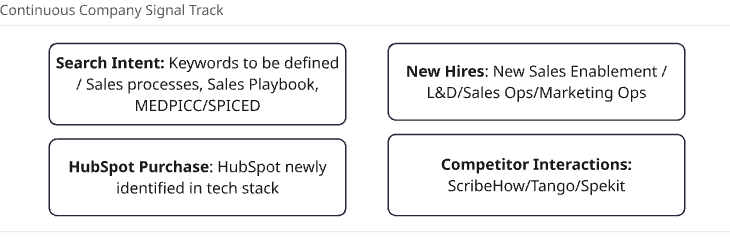
2. Tracking Signals Over Time

  • Accounts weren’t treated as “one-and-done” once they entered the system.
  • Signals continue to be monitored as new activity happens, such as:
     
    • Additional hires
    • Competitor engagement
    • Search behavior
    • HubSpot adoption signals

Only accounts that matched Supered’s ICP and buyer criteria were allowed into HubSpot. Everything else was filtered out before sales ever saw it.

continuous company signal track


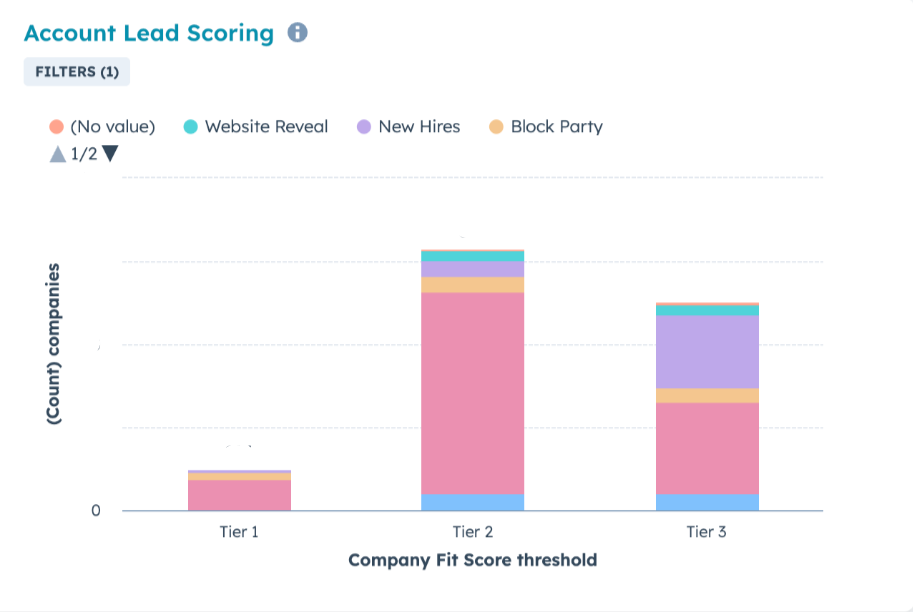
3. Scoring Intent at the Account Level

  • Signals were scored at the contact level first.
  • Those scores were then rolled up to the company level.
  • This made it possible to see when interest was isolated versus when multiple people inside the same account were engaging.

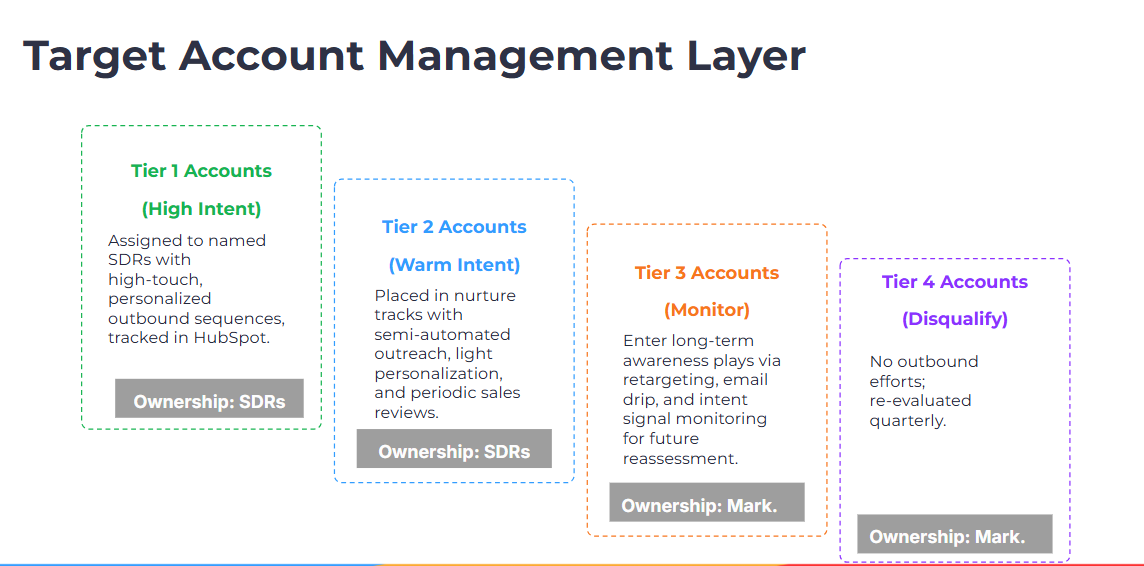
 4. Tiering Accounts to Protect Sales Capacity

  • Once intent scores were established, accounts were grouped into tiers automatically.
  • Each tier had a clear purpose:
     
    • Tier 1: High-intent accounts routed to high-touch, personalized outbound
    • Tier 2: Warm accounts worked more lightly by sales
    • Tier 3: Accounts monitored and nurtured by marketing
    • Tier 4: Disqualified or deprioritized accounts

This structure ensured sales reps spent time where it mattered most, and avoided being overwhelmed as volume increased.

target account management layer

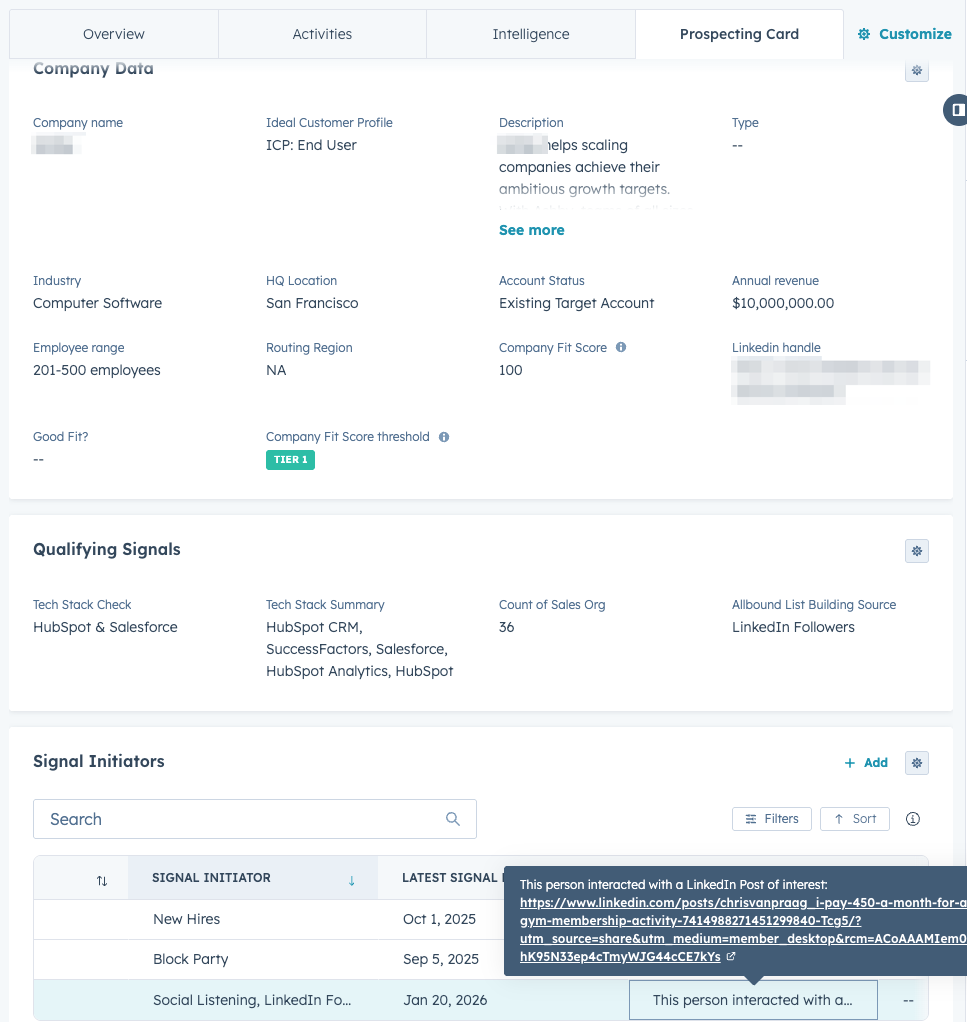
 5. Giving Sales Real Context With Prospecting Cards

  • All sourcing, enrichment, and scoring came together inside HubSpot through custom prospecting cards.
  • When a rep opens an account, they can immediately see:
     
    • Why the account qualifies as a fit
    • Which signals triggered it
    • Who inside the company initiated those signals
    • The most recent activity tied to the account

This allows reps to start with context which makes outreach more relevant, easier to personalize, and far more confident.

prospecting card

The Impacts


1. Sales Focus Shifted to the Right Accounts

  • Reps spent less time researching or guessing who to contact.
  • Outreach was focused on accounts already showing relevant signals.
  • Sales time was spent engaging, not qualifying from scratch.


supered account lead scoring
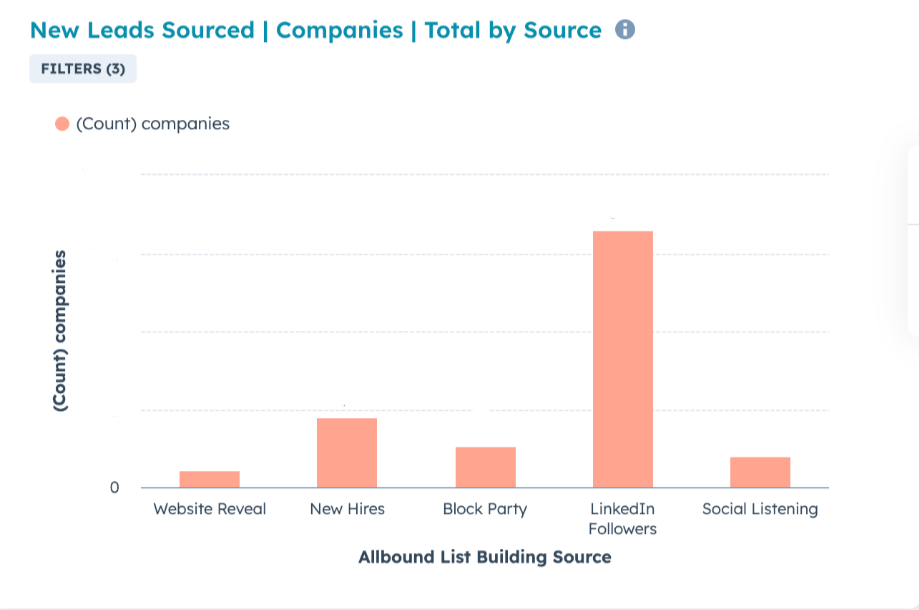
supered new leads sourced


2. Outreach Became Contextual

  • Signals like new hires, social engagement, website activity, and events gave reps a clear reason to reach out.
  • Conversations started with context instead of cold introductions.
  • Reps had visibility into why an account was prioritized

3. Lead Flow Became Consistent and Intentionally Capped

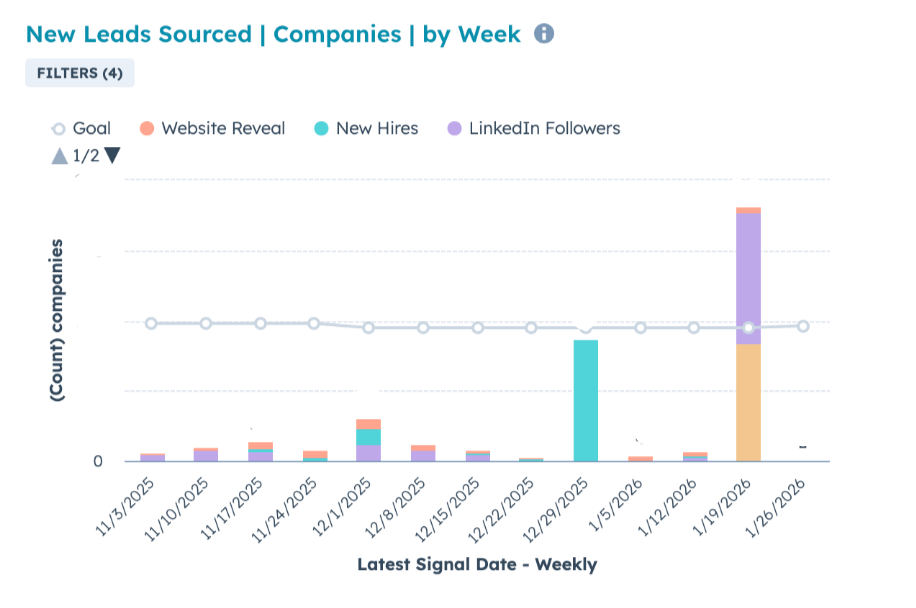
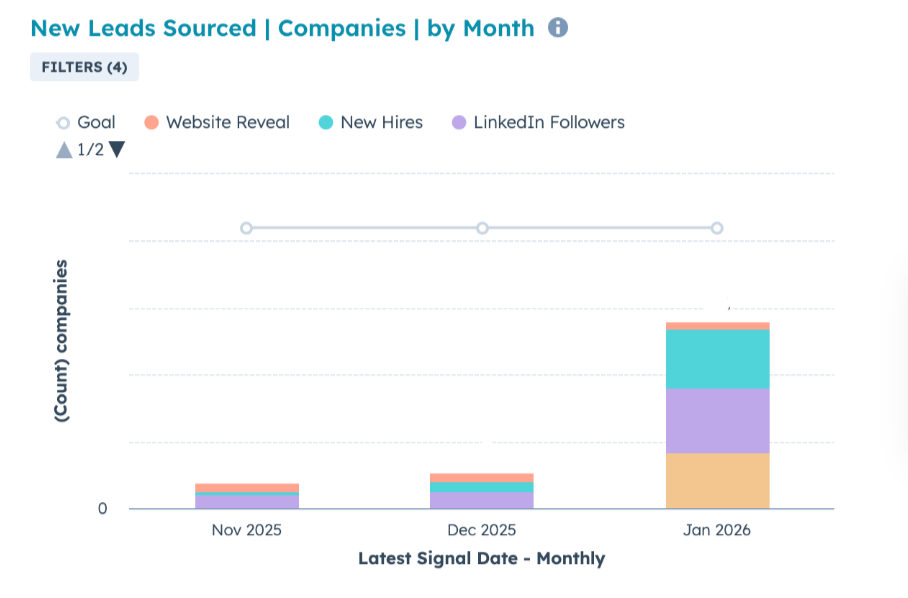
  • Weekly lead volume increased over time.
  • Variability was expected and planned for as signals normalized.
  • Some weeks reached the maximum number of accounts the sales team could realistically handle.
  • This cap protected sales capacity while still supporting growth

supered new leads sourced by week
supered new leads sourced by month


4. Early Pipeline and Meetings Were Generated

  • Meetings began booking from this motion within the first few months.
  • Deals started originating from signal-based outbound activity.
  • Even when attribution wasn’t perfectly linear, the system consistently contributed to pipeline creation

5. The System Scaled Without Adding Manual Work

  • New signals could be introduced without changing how sales operated.
  • Reps didn’t need to build lists, enrich data, or monitor signals themselves.
  • The system continued running in the background as activity increased
Schematic - Switch Box

RevPartners is at Your Service

Does your revenue engine need built, fine-tuned, or supercharged?

To learn more about how to continuously improve operational efficiency and identify the gaps in your customer experiences, see what RevPartners can do for you!