
The AI maturity curve helps GTM teams evaluate whether they're truly ready for AI. Instead of measuring how many AI tools you use, an AI maturity framework assesses the quality of your data, process architecture, connected systems, and workflows to determine whether AI can deliver reliable, scalable business results.
What everyone is asking: “How can we use AI?”
What everyone should be asking: “Are we ready for AI?”

Adding AI tools is the easy part.
But getting them to actually work requires the right data, processes, and systems behind them.
This guide breaks down the six areas that determine AI maturity: Data Model, Process Architecture, System Orchestration, Intelligence Layer, Human-AI Collaboration, and Adaptive Intelligence.
Key Takeaways About the AI Maturity Curve
- The AI maturity curve shows how ready your GTM team is to get real value from AI.
- AI works best when it has a strong foundation of accurate data, connected systems, and clear processes.
- An AI maturity assessment helps identify what needs to improve before your team can successfully scale AI.
- Adding AI on top of messy systems usually creates bigger problems instead of better results.
- The most mature GTM teams continuously improve their AI by learning from results and human feedback.
What Is the AI Maturity Curve?
Before breaking down the six areas that determine AI maturity, it’s important to understand what the AI maturity curve is.
The AI maturity curve is a framework for understanding how prepared an organization is to successfully use and scale AI.
It’s not measured by how many tools you buy or how many automations you create, but whether your organization has the foundation needed for AI to produce reliable results.
That difference matters as although 88% of organizations now use AI, only 38% have moved beyond pilot programs to scale AI across operations. The gap is no longer AI access. It’s AI readiness.
For GTM teams, that readiness depends on the data AI learns from, the processes it follows, the systems it connects with, and the people responsible for improving it.
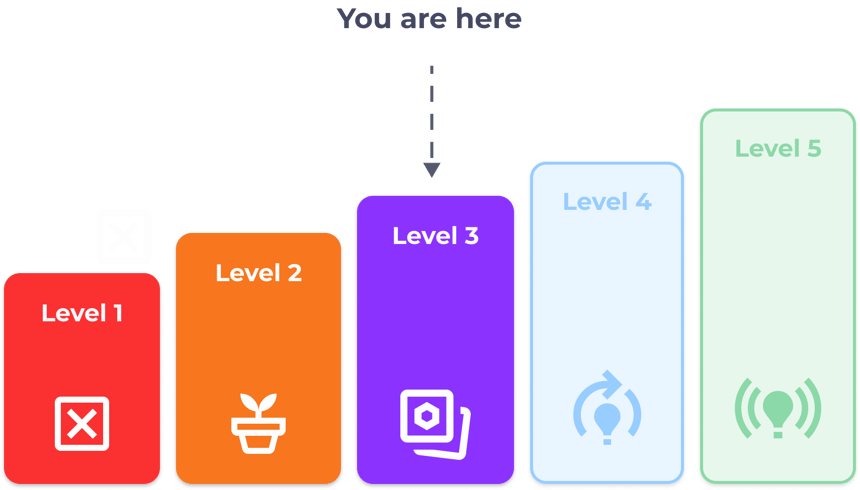
Think your GTM team is ready for AI? Take the AI GTM Maturity Assessment to identify the gaps in your data, processes, and systems before you scale. 👇
Why GTM Maturity Determines AI Success
Before a GTM team can improve with AI, it needs a strong foundation for AI to work from.
That foundation is GTM maturity, which measures how well your teams, data, processes, and systems work together.
This alignment has always been important. B2B organizations with tightly aligned sales and marketing operations achieve 24% faster three-year revenue growth. AI raises the stakes because it depends on those same connections to automate actions, identify opportunities, and improve decisions.
Your AI maturity measures how effectively AI can use that foundation to create better results.
For example, an AI tool connected to incomplete CRM data, unclear sales processes, and disconnected systems can only do so much. The technology may work, but the results will be limited by the information behind it.
With stronger GTM maturity, AI has the structure it needs to identify patterns, recommend next steps, automate workflows, and improve decisions.
So before measuring how advanced your AI is, start by looking at the six areas that determine whether your GTM foundation is ready.

The 6 Components of an AI Maturity Framework for GTM Teams
For GTM teams, the following six components help identify what’s working, what’s missing, and what needs to improve to move further along the AI maturity curve.
Component 1: Data Model
AI is only as useful as the information it has access to.
Before it can recommend the right accounts, automate the right actions, or predict future outcomes, it needs a complete and accurate view of your customers.
This is why data quality becomes even more important as teams adopt AI. Poor data quality already costs organizations an average of $12.9 million per year, and AI only increases the impact of those issues by acting on the information it receives.
A strong data model gives AI the inputs it needs to make better decisions.
Unified Customer Records
AI can’t work effectively if every system has a different version of your customer data.
Your CRM, marketing tools, sales platforms, and other systems need a shared understanding of:
- who your customers are
- how they interact with your business
- where they are in the customer journey
- what actions have already happened
When customer information is disconnected, AI has to make decisions with missing context.
Case Study: Zoobean 
See how we helped Zoobean create a stronger reporting foundation by improving attribution, data visibility, and GTM decision-making.
See the full case study HERE!
Real-Time Data Enrichment
Customer data changes constantly.
Companies grow, contacts change roles, priorities shift, and new buying signals appear.
AI-ready GTM teams use enrichment workflows to keep important information updated, including:
- company details
- contact information
- industry data
- buying signals
The more accurate your inputs are, the more useful your AI outputs become.
ICP Segmentation
AI needs to understand what a good opportunity looks like.
Clear ICP segmentation helps AI recognize which accounts match your best customers and deserve more attention.
This includes defining:
- ideal customer profiles
- target personas
- qualification criteria
- priority segments
Without clear segmentation, AI may help your team do more work without helping them focus on the right work.
Intent and Engagement Signals
A strong data model goes beyond basic customer information.
AI also needs to understand what people are doing.
That means connecting signals like:
- website activity
- content engagement
- product interest
- buying behavior
These signals help AI understand not only who to focus on, but when your team should take action.
AI needs more than data. It needs a revenue model it can understand. Learn how Revenue Performance Modeling helps GTM teams structure their data, lifecycle stages, and reporting foundation for smarter decisions. 👇
Component 2: Process Architecture
AI can’t improve a process your team hasn’t clearly defined.
Even with the right data, AI still needs structure. It needs to understand how your GTM team operates, what should happen next, and how success is measured.
Strong process architecture gives AI the rules it needs to support better decisions.
Documented GTM Playbooks
AI-ready teams have clear processes for how revenue moves through the business.
That includes defining:
- how leads enter the system
- when lifecycle stages change
- who owns each step
- how handoffs happen between teams
Without clear processes, AI doesn’t have a consistent path to follow.
Shared Definitions Across Teams
AI depends on everyone speaking the same language.
Sales, marketing, and customer success need shared definitions for things like:
- MQLs
- SQLs
- opportunities
- customer stages
If each team defines success differently, AI receives conflicting information and can’t accurately measure what’s working.
CRM-Based Adoption
Documenting a process isn’t the same as following a process.
Low-maturity GTM teams keep their rules in documents, spreadsheets, and slide decks that teams rarely use.
Mature GTM teams build those processes directly into their CRM through:
- workflows
- automation
- required information
- reporting
Case Study: Applied Ceramics 
See how we helped Applied Ceramics rebuild HubSpot around cleaner processes, stronger adoption, and a GTM foundation designed for better decisions.
Check out the full case study HERE!
This creates consistency and gives AI reliable patterns to learn from.
Optimization Loops
Your GTM process should improve as your business changes.
AI-ready teams continuously refine their processes using:
- sales team feedback
- customer insights
- performance data
These feedback loops help make sure AI is improving based on what is actually happening in the business.
Component 3: System Orchestration
AI is limited when your systems are disconnected.
Even with good data and clear processes, AI needs access to the full customer journey to understand what’s happening and recommend what should happen next.
System orchestration connects your GTM tools so information can move across your entire revenue engine.
Integrated GTM Technology
AI-ready teams don’t have important customer information trapped across different platforms.
Their systems work together, including:
- CRM
- marketing automation
- outbound tools
- customer platforms
- reporting
When these tools are connected, AI has a complete view of every customer interaction instead of only seeing one piece of the journey.
Operational Automation
Disconnected systems create manual work.
Teams spend time updating records, moving information between tools, and completing repetitive tasks that could happen automatically.
Mature GTM teams automate things like:
- routing
- enrichment
- notifications
- data updates
This allows teams to spend less time maintaining systems and more time acting on insights.
Dynamic Lifecycle Movement
Your customer journey is always changing, and your systems should reflect those changes.
AI-ready teams automatically update lifecycle stages and statuses based on:
- customer engagement
- qualification criteria
- pipeline activity
This gives AI a more accurate understanding of where every customer stands.
Shared Dashboards
AI maturity requires everyone working from the same information.
Shared dashboards help teams understand:
- funnel performance
- conversion rates
- pipeline velocity
- revenue leakage
When everyone trusts the same numbers, AI can help teams identify problems and find opportunities faster.
Component 4: Intelligence Layer
Once AI has reliable data, clear processes, and connected systems, it can start helping teams make better decisions.
This is where AI moves beyond completing simple tasks, and helps teams understand where to focus.
Intelligent Account Scoring
Not every account deserves the same amount of attention.
AI-ready GTM teams use scoring models to identify the accounts most likely to become customers based on factors like:
- customer fit
- engagement
- behavior
- intent signals
This helps teams prioritize the right opportunities instead of treating every account the same.
Automated Engagement Triggers
Timing matters.
When AI understands customer behavior, it can help teams act at the right moment.
For example, when a high-value account shows interest, AI can help trigger:
- account research
- personalized outreach
- recommended next steps
Instead of waiting for teams to find opportunities manually, AI helps bring important actions forward.
AI Recommendations
At higher levels of AI maturity, AI starts helping teams decide where to invest their time.
It can provide recommendations around:
- which accounts to prioritize
- which personas to engage
- which channels are performing best
AI becomes a tool for improving decisions, not just completing tasks.
Learning From Results
A strong intelligence layer gets better over time.
AI-ready teams use real performance data, including:
- conversion rates
- pipeline outcomes
- revenue results
These insights help AI recommendations improve as your GTM strategy evolves.
Component 5: Human-AI Collaboration
AI maturity happens when people know how to work with AI effectively.
Even the best AI systems still need human input, expertise, and feedback to create better results.
Embedded AI Workflows
AI creates the most value when it fits naturally into the way teams already work.
Instead of switching between separate tools, mature GTM teams use AI directly inside their:
- CRM
- sales processes
- marketing workflows
- reporting
This makes AI a consistent part of daily decisions instead of another tool people forget to use.
AI Literacy
Teams need to understand how to get the best results from AI.
That means knowing how to:
- ask better questions
- evaluate AI responses
- improve outputs over time
AI-ready teams understand how to guide AI.
Human Feedback
AI improves when people stay involved.
Teams provide the context AI doesn’t always have, including:
- experience
- strategic judgment
- corrections
This feedback helps AI become more useful and aligned with how the business actually operates.
Component 6: Adaptive Intelligence
The highest level of AI maturity happens when your GTM system continuously improves.
At this stage, AI is learning from results and helping the business adjust over time.
Organizations that scale AI successfully are 3.6x more likely to pursue transformational change instead of only looking for incremental improvements. That’s the difference between adding AI features and building a GTM system that gets smarter over time.
AI Governance
AI is only valuable when teams can trust it.
Mature GTM teams create standards that maintain:
- data quality
- system accuracy
- responsible AI usage
This ensures AI continues working from reliable information as the business grows.
Revenue Intelligence Dashboards
Teams need visibility into what’s happening across the revenue engine.
Strong reporting helps measure:
- conversion rates
- pipeline velocity
- funnel leakage
- overall performance
These insights show where the GTM system is working and where improvements need to happen.
Closed Feedback Loops
The most mature AI systems improve because they learn from what happens.
Teams create a cycle where:
Reporting → Insights → System Updates → Better Execution
Instead of making decisions based on assumptions, teams continuously improve based on real results.
Continuous Optimization
Markets change. Customers change. GTM strategies change.
AI-ready organizations build systems that can adapt with those changes.
By continuously improving data, processes, workflows, and AI models, teams create a revenue engine that gets smarter over time.
Recap: Moving Up the AI Maturity Curve
Moving up the AI maturity curve is about building a stronger foundation that allows AI to create better results.
Before AI can transform your GTM strategy, your team needs to answer six important questions:
- Data Model: Can AI trust the information it is using?
- Process Architecture: Does AI understand how your team operates?
- System Orchestration: Can AI access the systems it needs?
- Intelligence Layer: Can AI help your team make better decisions?
- Human-AI Collaboration: Can your team effectively work with AI?
- Adaptive Intelligence: Does your system improve over time?
The GTM teams that succeed with AI will be the ones with the strongest foundation for AI to build on.
Want to know if your GTM foundation is actually ready for AI? Take our AI Readiness for GTM Teams RPX course and learn how to move from AI experimentation to scalable AI execution. 👇
Frequently Asked Questions About the AI Maturity Curve
What is the AI maturity curve?
The AI maturity curve is a framework that measures how prepared an organization is to successfully use, scale, and improve AI.
It evaluates whether a company has the right data, processes, systems, and people in place to get reliable results from AI.
What is an AI maturity assessment?
An AI maturity assessment evaluates how ready an organization is to successfully adopt and scale AI.
A strong AI maturity assessment looks beyond the number of AI tools a company uses. It measures areas like data quality, process maturity, system integration, AI adoption, and the ability to continuously improve AI performance.
What should an AI maturity framework include?
An AI maturity framework should include the key areas that determine whether AI can create meaningful business results.
For GTM teams, an AI maturity framework should evaluate six components: Data Model, Process Architecture, System Orchestration, Intelligence Layer, Human-AI Collaboration, and Adaptive Intelligence.
How does GTM maturity impact AI success?
GTM maturity impacts AI success because AI depends on the quality of the revenue system behind it.
Teams with strong GTM maturity have cleaner data, clearer processes, connected technology, and better feedback loops. This gives AI the foundation needed to make accurate recommendations and improve decisions.
What is the difference between AI adoption and AI maturity?
AI adoption measures whether a team is using AI. AI maturity measures whether a team is prepared to get reliable results from AI.
A company can have high AI adoption but low AI maturity if employees are using AI tools without the data, processes, and systems needed to support them.
How do you improve AI maturity?
Organizations can improve AI maturity by strengthening the foundation AI relies on.
This includes improving data quality, documenting processes, connecting systems, building AI into daily workflows, and creating feedback loops that help AI improve over time.
Ready to move up the AI maturity curve? Take the AI GTM Maturity Assessment to see where your team stands and what needs to improve next. 👇
-4.png)