-4.png)
An Allbound strategy is a unified go-to-market (GTM) approach that connects inbound marketing, outbound sales, and paid media into one coordinated revenue engine. By combining buyer intent data, CRM automation, shared metrics, and cross-channel engagement, businesses can lower customer acquisition costs, shorten sales cycles, improve sales and marketing alignment, and generate more predictable growth.
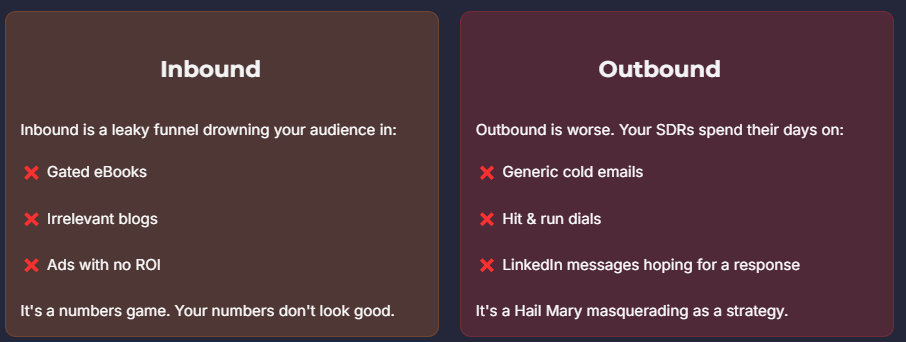
Does your company rely on inbound-only strategies?
That means you’re playing the long game, but often at the expense of real pipeline. SEO, content marketing, and lead magnets take months to generate traction, and even then, most leads stall before converting.
What about outbound-only?
Well, it’s a high-cost, low-efficiency grind. SDRs burn through lists with cold emails, scripted LinkedIn messages, and generic outreach, hoping something sticks. This approach tends to burn cash fast and often stops working as markets get crowded.
And paid media?
Many companies treat Google Ads and LinkedIn Ads as disconnected tactics, when in reality, they should fuel and amplify inbound and outbound efforts, not work in isolation.
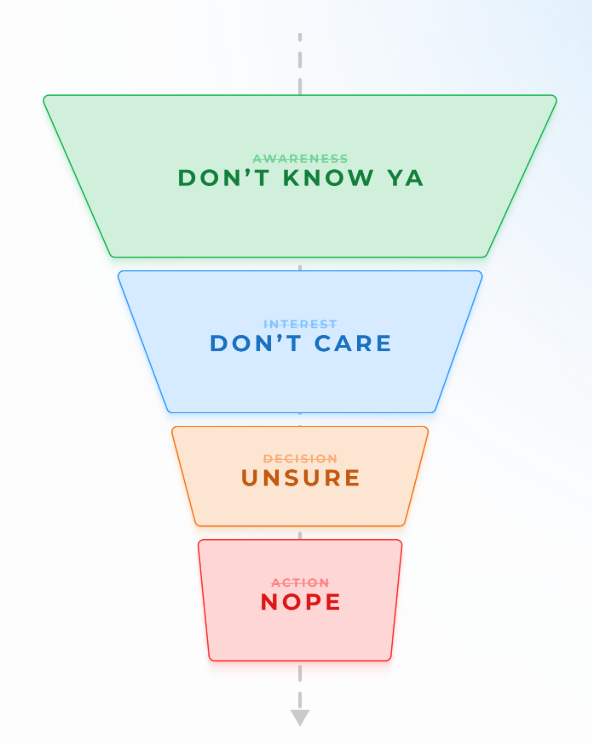
Meanwhile, modern buyers don’t follow a neat sales funnel.

They control their own customer experience, moving fluidly between Google searches, LinkedIn discussions, product review sites, and Slack communities before they ever engage with sales.
Key Takeaways: What an Allbound Strategy Actually Does
-
Combines inbound, outbound, and paid media into one connected revenue engine.
-
Turns buyer intent signals into pipeline.
-
Aligns marketing and sales so no leads get lost in silos.
-
Lowers CAC, shortens sales cycles, and makes growth more predictable.
-
The old way is disconnected and slow. Allbound is fast, efficient, and built for how B2B buyers buy now.
This is why 72% of B2B buyers expect a mix of inbound and outbound.
The companies thriving today have figured out the secret: Allbound.
The companies thriving today aren’t choosing between inbound, outbound, and paid media, they’re combining them.
It’s called Allbound. And it’s changing how businesses scale.
What Is an Allbound Strategy?
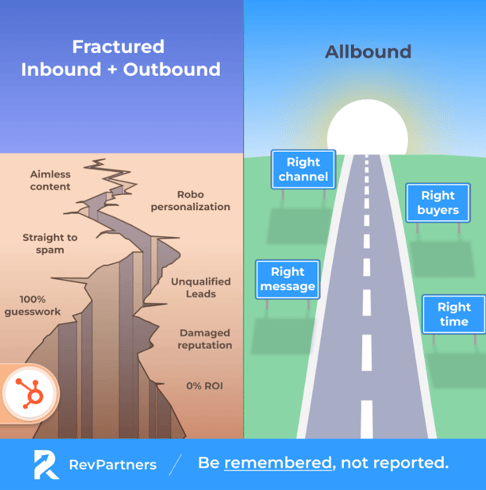
Allbound is a fully connected sales and marketing strategy that integrates inbound, outbound, and paid media into a single revenue-driving system.
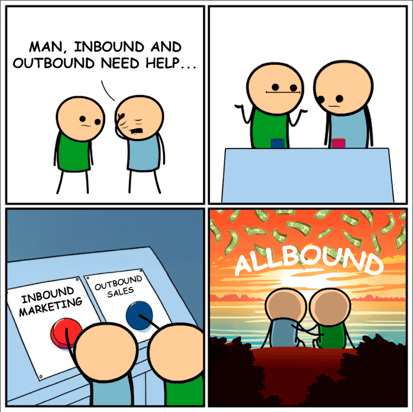
Unlike traditional models where these channels operate separately, Allbound makes them work together, leading to:
- 30-50% improvement in revenue efficiency.
- Higher conversion rates and lower acquisition costs.
- Faster deal velocity, shorter sales cycles, and scalable growth.
How It Works
- Inbound generates demand (content, SEO, lead generation).
- Outbound turns interest into action (cold outreach, ABM, retargeting).
- Paid media amplifies both (Google Ads, LinkedIn Ads, remarketing).
Five Reasons Allbound Should Be Your Revenue Engine
1. More Leads, Lower Spend
Most companies overspend on sales and marketing because they treat inbound, outbound, and paid media separately, leading to wasted budget and higher Customer Acquisition Costs (CAC).

An Allbound reduces CAC because it:
- Uses inbound to attract high-intent leads at a lower cost.
- Directs outbound efforts toward engaged prospects, not cold lists.
- Leverages paid media to drive pipeline, not just impressions.
2. Shorter Sales Cycles, Higher Win Rates
The longer a deal drags on, the less likely it is to close. If you’re waiting for inbound leads to take action, you’re missing out on revenue and leaving target accounts in limbo.
Allbound reduces sales cycles by up to 23% by:
- Using inbound to pre-educate buyers before outbound reaches out, aligning messaging across multiple channels.
- Making outbound proactive, so sales doesn’t wait for prospects to act.
- Leveraging paid media for real-time engagement, keeping your brand top-of-mind.
3. Stop the Sales vs. Marketing Blame Game
Sales teams complain that marketing sends bad leads.
Marketing complains that sales doesn’t follow up.
Sound familiar?

Disconnected systems? Check out our webinar with Clay! 👇
On the flip side, companies using Allbound report better sales-marketing alignment.
Why? Because both teams are measured on the same revenue goal, not separate KPIs.
4. Paid Media Should Fuel Your Entire GTM, Not Just Demand Gen
Most companies run Google and LinkedIn Ads as isolated efforts—instead of making them a core part of their GTM strategy.
- Paid media should warm up outbound efforts. If a prospect clicks a LinkedIn ad but doesn’t convert, outbound should engage them via email or call.
- Retargeting should support inbound. If a lead downloads a whitepaper but doesn’t take action, Google and LinkedIn ads should bring them back.
- Sales should know what ads their prospects engage with. If a prospect watched a video ad on LinkedIn, reps should reference that in their outreach.
5. Sustainable, Predictable Growth Needs Balance
If your company relies too heavily on one channel, your growth is at risk.
- Inbound alone takes too long to build pipeline.
- Outbound is expensive and unpredictable without a warm lead pool.
- Paid media burns budget if not strategically connected to inbound and outbound efforts.
Allbound keeps pipeline balanced and predictable by ensuring:
- Inbound builds long-term demand.
- Outbound delivers short-term pipeline control.
- Paid media amplifies both, keeping prospects engaged across channels.
Lead the Allbound Revolution. Or Get Left Behind
The old way of selling is dead.

- Inbound alone takes too long to generate pipeline.
- Outbound alone is too expensive without warm leads.
- Paid media alone burns budget if not connected to sales motions.
Disconnected GTM motions waste effort, frustrate buyers, and stall revenue growth.
Companies using Allbound see higher conversion rates, faster deal velocity, and lower CAC.
The real question isn’t “Should you use Allbound?”
It’s “How much revenue are you losing by not using it?”
Recap: Why an Allbound Strategy Is the Future of B2B Growth
To build an effective Allbound strategy, organizations should focus on:
- Unify inbound, outbound, and paid media: Connect every channel through shared buyer data, coordinated messaging, and common revenue goals instead of managing isolated campaigns.
- Use buyer intent to prioritize engagement: Turn website visits, content downloads, ad interactions, webinar attendance, and other buying signals into timely, personalized sales outreach.
- Align sales and marketing around revenue: Replace channel-specific KPIs with shared metrics like pipeline creation, conversion rates, customer acquisition cost (CAC), and revenue attribution to eliminate silos and improve execution.
- Make paid media part of your GTM engine: Use paid campaigns to reinforce inbound content, warm outbound accounts, retarget engaged buyers, and accelerate active opportunities rather than treating advertising as a standalone tactic.
- Centralize execution inside your CRM: Use HubSpot as the operational hub for lead scoring, lifecycle management, automation, attribution, reporting, and cross-functional visibility.
- Continuously optimize every GTM motion: Measure pipeline velocity, sales cycle length, conversion rates, CAC, and attributed revenue to refine your Allbound strategy and improve long-term performance.
Frequently Asked Questions About Allbound Strategy
What is an Allbound strategy?
An Allbound strategy combines inbound marketing, outbound sales, and paid media into a single GTM system. Instead of running separate campaigns and teams, Allbound connects buyer signals, outreach, content, and advertising into one coordinated revenue engine.
How is Allbound different from inbound marketing?
Inbound marketing focuses on attracting buyers through content, SEO, webinars, and educational resources.
Allbound uses those inbound signals to trigger outbound actions and paid media engagement, helping companies convert interest into pipeline faster.
How is Allbound different from outbound sales?
Traditional outbound relies on prospect lists and cold outreach.
Allbound prioritizes outreach based on buyer behavior, engagement signals, and intent data, making outbound more relevant and effective.
Why are inbound-only strategies becoming less effective?
Inbound can generate awareness and engagement, but many buyers consume content without ever taking the next step.
Without proactive engagement, leads often stall before reaching Sales.
Why do outbound-only strategies struggle?
Outbound becomes less effective when teams rely on generic messaging and cold lists without buyer context.
Modern buyers expect relevance, personalization, and timing based on their actual interests and needs.
What is channel isolation?
Channel isolation occurs when inbound, outbound, and paid media operate independently without sharing data, reporting, or buyer signals.
This often results in:
- duplicate efforts
- poor attribution
- missed opportunities
- inconsistent buyer experiences
Why do modern B2B buyers require a different GTM approach?
Today's buyers move across multiple channels before speaking with Sales.
They often research through:
- review sites
- communities
- webinars
- peer recommendations
A disconnected GTM motion struggles to keep up with this behavior.
How does Allbound reduce Customer Acquisition Cost (CAC)?
Allbound improves CAC by:
- using inbound to attract intent-driven buyers
- prioritizing outbound toward engaged prospects
- improving paid media targeting
- reducing wasted outreach
This creates more efficient pipeline generation.
How does Allbound shorten sales cycles?
Allbound shortens sales cycles by:
- identifying intent earlier
- educating buyers before outreach
- aligning messaging across channels
- keeping prospects engaged throughout the buying journey
This reduces friction and accelerates decision-making.
Why do sales and marketing teams become misaligned?
Misalignment typically happens when:
- teams use different metrics
- systems aren't connected
- lead definitions vary
- handoffs are inconsistent
Allbound helps solve this by creating shared visibility and shared revenue goals.
How should paid media support an Allbound strategy?
Paid media should reinforce inbound and outbound efforts rather than operate independently.
Examples include:
- retargeting engaged website visitors
- warming outbound accounts
- amplifying high-performing content
- reinforcing active sales conversations
This creates a more connected buyer experience.
What buyer signals should Allbound teams track?
Common buyer signals include:
- pricing page visits
- content downloads
- webinar attendance
- ad engagement
- repeat website visits
- community participation
- email engagement
These signals help determine when outreach should happen.
What metrics should companies track in an Allbound strategy?
Important metrics include:
- Customer Acquisition Cost (CAC)
- sales cycle length
- conversion rates
- pipeline generated
- pipeline velocity
- opportunity creation
- attributed revenue
- customer lifetime value
These metrics connect GTM activity directly to revenue outcomes.
How does HubSpot support an Allbound strategy?
HubSpot serves as the central source of truth for:
- attribution
- workflows
- lead scoring
- lifecycle stages
- automation
- reporting
It helps coordinate inbound, outbound, and paid media activities inside one system.
What are the benefits of an Allbound strategy?
Organizations often use Allbound to:
- lower CAC
- increase conversion rates
- shorten sales cycles
- improve attribution
- align sales and marketing
- improve pipeline predictability
- create more efficient growth
What are the best practices for implementing Allbound?
Best practices include:
- centralizing GTM data
- connecting inbound and outbound workflows
- tracking buyer intent
- aligning sales and marketing KPIs
- integrating paid media into outreach motions
- automating follow-up
- measuring revenue impact instead of lead volume
These practices help create a scalable revenue engine.
-1.png)
-3.png)