
An Allbound marketing strategy combines inbound marketing, outbound sales, and paid media into a unified go-to-market (GTM) system that attracts, engages, and converts buyers across every stage of the customer journey. By aligning sales and marketing, leveraging buyer intent data, and centralizing execution in a CRM, businesses can generate more qualified pipeline, lower customer acquisition costs, and achieve predictable, scalable growth.
If your business is still relying solely on inbound or outbound marketing, it’s time to wake up. The old way of doing things isn’t cutting it anymore. Customers are more sophisticated, competition is fiercer, and fragmented strategies leave money on the table. Enter the allbound strategy, the future of marketing that combines the best of inbound and outbound methods. It’s direct, dynamic, and designed to deliver results.
An allbound approach is not just a strategy; it’s a necessity for businesses that are serious about growth. Let’s break down the top five benefits of adopting an allbound marketing approach and why it’s the solution you’ve been searching for. By the end of this, you won’t just want to shift gears; you’ll need to.
Key Takeaways: Why does Allbound outperform inbound-only and outbound-only strategies?
-
-
Combines inbound and outbound for full-funnel coverage.
-
Fills your pipeline faster with better-fit leads, not just more leads.
-
Aligns sales + marketing so no leads get lost or wasted.
-
Shrinks sales cycles and boosts conversions with smarter targeting.
-
Creates sustainable, scalable growth instead of random wins.
-
How does Allbound maximize lead generation?
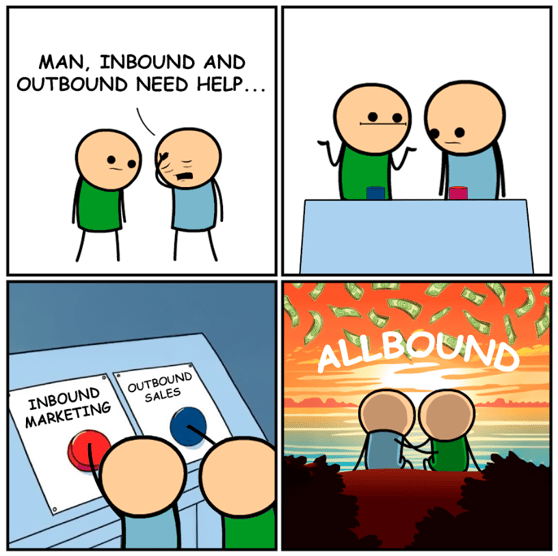
Relying solely on inbound marketing often means you’re sitting back and waiting for leads to find you. While inbound is valuable, it’s a passive approach. Outbound marketing, on the other hand, puts you in the driver’s seat. The genius of an allbound strategy is its ability to merge these two worlds seamlessly.
With inbound strategy, you attract leads through valuable content, SEO, and organic engagement on social media and other channels. With outbound strategy, you’re proactively targeting high-value prospects through tactics like cold calling, personalized outreach, and account-based advertising to reach your target audience. The result? You’re casting a wider net while simultaneously focusing on the leads that matter most.
When lead generation is maximized, your sales pipeline stays full — and that’s how you grow.
How does Allbound shorten sales cycles and speed up revenue?
One of the biggest bottlenecks in growing businesses is a slow sales cycle. Prospects linger in the pipeline, unsure about taking the next step. This delay is often caused by misalignment between marketing and sales or an over-reliance on a single communication channel.
An allbound marketing approach attacks this problem head-on. By combining inbound strategy nurturing content with outbound strategy targeted outreach, your sales team delivers the right message at the right time to effectively nurture leads through the sales funnel. While inbound educates and builds trust, outbound gives them the push they need to take action. It’s a one-two punch that accelerates decision-making.
With an allbound strategy, your team becomes a synchronized force, leading prospects down the funnel with precision. Expect shorter sales cycles and faster revenue generation. Time is money, and allbound gives you both.
How does Allbound improve alignment between sales and marketing?
Sales blames marketing for poor leads. Marketing blames sales for not closing deals. Sound familiar? This divide between teams is one of the most common and costly inefficiencies in business.
An allbound strategy is built on collaboration. It forces your sales team and marketing team to work together, aligning their goals and sharing real-time data to drive better outcomes and improve the customer experience. Outbound efforts are informed by the insights gathered from inbound campaigns, and inbound campaigns are optimized based on the feedback loop from outbound activities.
When sales and marketing align, magic happens. Lead quality improves, handoffs are seamless, and both teams operate as a cohesive unit.
How does Allbound improve customer targeting and ROI?
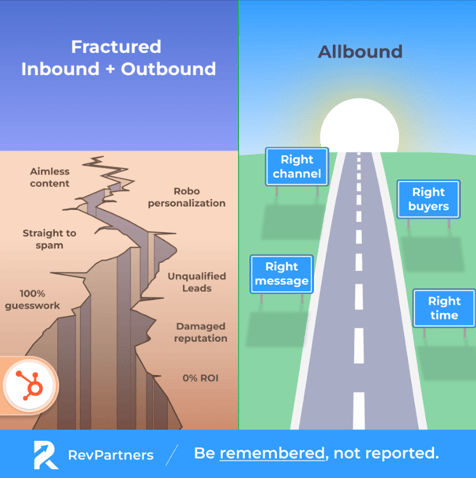
The beauty of an allbound marketing approach lies in its precision. Inbound marketing helps you identify who is already interested in your product or service, while outbound marketing ensures you’re actively pursuing those who might not yet know about you but are a perfect fit.
This dual approach allows you to zero in on your ideal customer profile (ICP) by identifying key pain points and tailoring messaging to meet the needs of your target audience. By leveraging data and insights from inbound efforts like website analytics and content performance, you can refine your outbound campaigns with laser focus. You’re not just targeting broadly; you’re targeting intelligently.
Improved targeting means less wasted effort and more ROI. Instead of casting a blind net, every action is intentional and every message is relevant. Businesses using allbound strategies report higher conversion rates and better customer retention because they’re consistently connecting with the right audience.
How does Allbound create scalable and sustainable growth?
Growth is great, but sustainable growth? That’s where the real challenge lies. Many businesses experience bursts of success from either inbound or outbound tactics, only to hit a plateau when the strategy stops scaling.
An allbound strategy ensures you’re building a scalable marketing engine. Inbound strategy lays the groundwork by creating content like blogs, guides, and SEO-optimized pages, building brand awareness and driving organic lead generation, while outbound strategy accelerates customer acquisition. Outbound provides the agility to adapt quickly, targeting new markets or audiences as your business grows. Together, these approaches create a self-sustaining cycle of growth.
With an allbound approach, your business becomes adaptable, resilient, and ready for whatever the market throws at you. It’s not just about growing faster; it’s about growing smarter.
Why "Allbound as a Service" is the Solution You Need
Implementing an allbound strategy isn’t just an option anymore, it’s a necessity. But building and executing this type of integrated strategy takes expertise, tools, and bandwidth. That’s where our "Allbound as a Service" comes in.
We take the guesswork out of the equation. From crafting tailored campaigns to aligning your sales team and marketing team, we deliver a turnkey solution that boosts marketing efforts, improves customer experience, and drives long-term results from day one. Our team becomes an extension of yours, ensuring your business is equipped to dominate in this new marketing era.
Recap: The Top Benefits of an Allbound Marketing Strategy
To maximize the benefits of an Allbound strategy, organizations should focus on:
- Generate more qualified pipeline: Combine inbound demand generation with targeted outbound outreach and paid media to engage both active buyers and high-fit prospects before competitors do.
- Accelerate sales cycles: Use buyer intent signals, personalized engagement, and coordinated follow-up across channels to move prospects through the buying journey faster.
- Align sales and marketing around revenue: Replace disconnected KPIs with shared pipeline, conversion, and revenue metrics so every team contributes to the same business outcomes.
- Improve customer targeting and marketing ROI: Build a clear Ideal Customer Profile (ICP), use CRM insights to prioritize high-value accounts, and deliver more relevant messaging across every touchpoint.
- Create sustainable, scalable growth: Balance inbound, outbound, and paid media so pipeline generation isn't dependent on a single acquisition channel or marketing tactic.
- Continuously optimize GTM performance: Measure Customer Acquisition Cost (CAC), conversion rates, pipeline velocity, revenue attribution, and customer lifetime value to improve every stage of your Allbound strategy.
Frequently Asked Questions About Allbound Marketing
What is an Allbound marketing strategy?
An Allbound marketing strategy combines inbound marketing, outbound sales, and paid media into a single GTM system. Instead of operating separately, all channels work together to attract, engage, and convert buyers throughout the customer journey.
How is Allbound different from inbound marketing?
Inbound marketing focuses on attracting buyers through content, SEO, webinars, and organic engagement.
Allbound takes those inbound signals and combines them with outbound outreach and paid media to create a more complete revenue engine.
How is Allbound different from outbound marketing?
Traditional outbound focuses on proactively reaching prospects through email, calls, LinkedIn, and account-based outreach.
Allbound enhances outbound by using inbound engagement and buyer intent signals to determine who should be contacted and when.
Why are inbound-only strategies limiting growth?
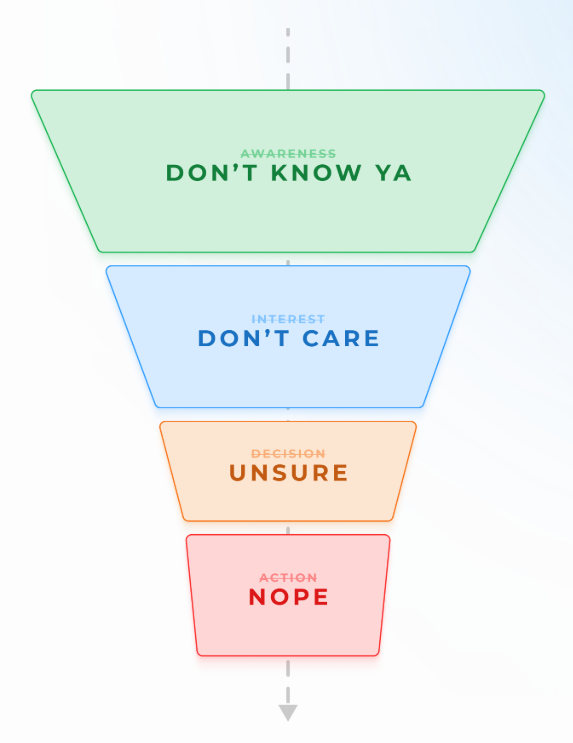
Inbound is effective at generating awareness and trust, but it often relies on prospects taking the next step themselves.
Without proactive engagement, many qualified prospects consume content and disappear before entering pipeline.
Why are outbound-only strategies becoming less effective?
Outbound performance suffers when outreach is:
- generic
- poorly targeted
- disconnected from buyer intent
- based on static prospect lists
Modern buyers expect relevance and timing, not mass outreach.
What are the biggest benefits of an Allbound strategy?
Organizations typically use Allbound to:
- generate more qualified pipeline
- lower Customer Acquisition Cost (CAC)
- shorten sales cycles
- improve sales and marketing alignment
- increase conversion rates
- improve revenue predictability
How does Allbound improve lead generation?
Allbound combines the strengths of inbound and outbound.
Inbound attracts interested prospects while outbound proactively engages high-fit accounts.
Together they create more opportunities than either channel can generate independently.
How does Allbound shorten sales cycles?
Allbound keeps prospects engaged across multiple channels throughout the buying journey.
By combining education, personalization, and proactive outreach, buyers often reach decisions faster than they would through a single-channel experience.
Why does sales and marketing alignment matter?
When sales and marketing operate independently:
- lead quality suffers
- follow-up slows down
- attribution becomes unreliable
- conversion rates decline
Allbound aligns both teams around shared pipeline and revenue goals.
How does Allbound improve customer targeting?
Allbound uses inbound engagement, intent data, CRM insights, and outbound research to identify ideal prospects more accurately.
This allows companies to focus resources on accounts that are most likely to convert and retain.
What is an Ideal Customer Profile (ICP)?
An Ideal Customer Profile (ICP) defines the characteristics of companies most likely to become successful long-term customers.
Common ICP criteria include:
- industry
- company size
- technology stack
- buying triggers
- revenue range
- growth stage
Strong ICPs improve targeting and campaign performance.
How does Allbound improve marketing ROI?
Allbound improves ROI by helping teams:
- reduce wasted outreach
- improve targeting
- increase conversion rates
- align campaigns with buyer behavior
- optimize spending across channels
This typically results in more efficient revenue generation.
How does paid media fit into an Allbound strategy?
Paid media amplifies inbound and outbound efforts.
Examples include:
- retargeting engaged prospects
- supporting account-based campaigns
- reinforcing outbound messaging
- increasing visibility among target accounts
Paid media becomes more effective when connected to the broader GTM motion.
What metrics should companies track in an Allbound strategy?
Key metrics include:
- Customer Acquisition Cost (CAC)
- pipeline created
- conversion rates
- sales cycle length
- revenue influenced
- customer lifetime value
- win rates
- attributed revenue
These metrics help connect marketing and sales activity directly to business outcomes.
What is Allbound as a Service?
Allbound as a Service (AaaS) is a managed GTM model where a specialized team builds, operates, and optimizes an Allbound system on behalf of a company.
This often includes strategy, execution, automation, reporting, and sales-marketing alignment.
Is Allbound only for large companies?
No.
Companies of all sizes can benefit from Allbound principles.
Smaller organizations often use Allbound to maximize limited resources, while larger organizations use it to improve efficiency and alignment across teams.
What are the best practices for implementing Allbound?
Best practices include:
- aligning sales and marketing goals
- defining a clear ICP
- connecting CRM data
- tracking buyer intent
- integrating paid media into GTM workflows
- measuring revenue impact
- continuously optimizing based on performance
These practices create a more scalable and predictable growth engine.
-4.png)
-1.png)
-1.png)