GTM engineering and RevOps sound similar, but they're not the same job. GTM engineers build new systems, like Clay and outbound automation. RevOps manages and improves the processes a company already has. Here's how the two differ and which one you need.
A lot of people use the terms GTM Engineering and RevOps interchangeably.

That’s a bad idea.
And it could also be an expensive one because if you hire the wrong one, you end up with someone great at managing a CRM but with no ability to build the automation you actually needed, or someone who can code but has zero interest in fixing why sales and marketing report different numbers every quarter.
This guide will break down what GTM engineering means, how it's different from RevOps, and how to tell which one your company needs right now. We'll also cover where Clay fits into all of this, since it's become one of the clearest signals of what a GTM engineer builds day to day.
Key Takeaways
- GTM engineering builds new systems, RevOps runs and improves the ones you already have
- GTM engineers write code and build tools like Clay workflows for automated enrichment and outbound
- RevOps owns process, data governance, and keeping sales, marketing, and customer success aligned
- Hire a GTM engineer when you know what to automate but have no one who can build it
- Hire RevOps when your teams have bad data, misaligned reporting, or no one owning the process
- Some companies combine both into one hybrid hire early on, then split the roles as they scale
What Is GTM Engineering?
GTM engineering is a technical role built around one idea: instead of managing the tools a company already has, you build new ones.
What Does a GTM Engineer Do?
A GTM engineer spends their day writing SQL, working in Python, connecting different tools through APIs, and setting up pipelines that move data around on their own instead of someone doing it by hand every time.
Clay is the clearest example of this in action. A rep used to have to research each lead manually, checking job changes, hiring trends, company info, one at a time. Now, a GTM engineer builds a Clay table that does all of that automatically. New lead comes in, it gets pulled, scored, and enriched without anyone touching it. Once it's built, it just runs.
Where Did GTM Engineering Come From?
The role showed up because companies kept hitting the same wall.
Sales and marketing teams wanted more automation and smarter systems, but the people running RevOps or sales engineering weren't hired to code or build infrastructure, they were hired to manage what already existed. As more companies looked for people who could bridge that gap, GTM engineering roles grew 205% year over year between 2024 and 2025.
And as tools like Clay have gotten more powerful and outbound has leaned harder into automation, more companies are looking for someone who can build this stuff instead of piecing it together themselves.
What Is RevOps?
RevOps runs the process side of a company, making sure sales, marketing, and customer success are all working off the same playbook instead of three different ones. It's not a coding heavy role as most of the job is keeping what's already in place working together.
Looking for a masterclass on the basics of RevOps? Check out our RPX course on RevOps Fundamentals 👇
What Does RevOps Own?
RevOps owns how a business runs day to day on the ops side, figuring out how a lead moves through the pipeline, keeping the CRM data clean, and making sure sales, marketing, and customer success are all looking at the same numbers. When something breaks between teams, like deals getting logged differently depending on who typed them in, RevOps is usually the one who catches it and fixes it.
What Skills Does a RevOps Professional Need?
This job runs on people skills as much as technical ones. A good RevOps professional works well across departments, takes what sales needs and turns it into something marketing can act on, and thinks through how one change in the CRM ripples out and hits every team downstream. Some technical skill helps, usually HubSpot or Salesforce setup, but nowhere near the coding depth a GTM engineer needs.
Want to learn more advanced RevOps strategy? Check out our RevOps 201 RPX course 👇
Where Did RevOps Come From?
RevOps came out of a simpler problem than GTM engineering did. As companies grew, sales, marketing, and customer success kept ending up with separate tools, data, and goals, even though they were all chasing the same revenue number.
RevOps showed up to close that gap, and adoption has steadily grown since. Today, 48% of companies have a dedicated RevOps function, up from 33% in 2020. That's not just because the role is becoming more common. Companies that invest in RevOps see 36% higher revenue growth, making it one of the fastest-growing functions in modern go-to-market teams.
When to Hire a GTM Engineer
A GTM engineer makes sense once your team knows what it wants to automate, but doesn't have anyone who can actually build it. For many companies, that need starts to emerge around the $5 million to $10 million ARR mark, when GTM complexity outgrows manual processes and point solutions.
Signs You Need a GTM Engineer
- You want to automate lead enrichment or outbound signals in Clay, pulling in job changes, hiring surges, or intent data the moment it happens, but nobody on the team can actually build the workflow
- Your reps are still researching every lead manually and sending one-off outreach that could easily run itself
- You've got a growing tech stack but no one connecting the tools together so data actually flows between them
If any of that sounds familiar, the bottleneck is building. A GTM engineer builds the infrastructure so outbound and enrichment run on logic and automation instead of relying on a rep's time every single day.
When to Hire a RevOps Professional
RevOps makes sense once your team has grown past the point where one person can keep everything straight, and things are starting to slip through the cracks.
Signs You Need a RevOps Professional
- Sales, marketing, and customer success are all reporting different numbers, and nobody's sure which one is actually right
- Leads are falling through the cracks between teams, or getting logged inconsistently depending on who touches them
- You've outgrown the one generalist trying to manage sales ops, marketing ops, and reporting all at once
- Your tech stack has grown, but no one owns making sure the data across it stays clean and consistent
If any of that sounds familiar, the problem is a missing owner. RevOps steps in to fix the process, clean up the data, and make sure every team is finally working off the same numbers.
Can One Person Do Both?

Short Answer
Yes, especially early on.
Longer Answer
A lot of companies right now are hiring what's basically "RevOps plus Clay." Someone who understands process, data governance, and cross functional alignment, but can also build inside Clay to automate the workflows RevOps used to have to request from someone else and wait on.
Instead of RevOps flagging that lead enrichment is a mess and filing a ticket for someone technical to fix it, this person just builds the fix themselves.
That combo works well when the team is small and the volume of work in each area is manageable. One person can own the process and still find time to build.
The tradeoff shows up as the company scales. Once you've got multiple GTM motions running, a growing tech stack, and process work piling up on its own, doing both well gets hard. Building a new Clay workflow takes focused, uninterrupted time. So does fixing a broken reporting process across three teams. Try to do both at once and one of them slips.
Most companies that start with a hybrid hire eventually split the roles because there's just too much work in each lane once headcount and complexity catch up.

Recap: GTM Engineering vs. RevOps
To determine whether you need GTM Engineering, RevOps, or both, organizations should focus on:
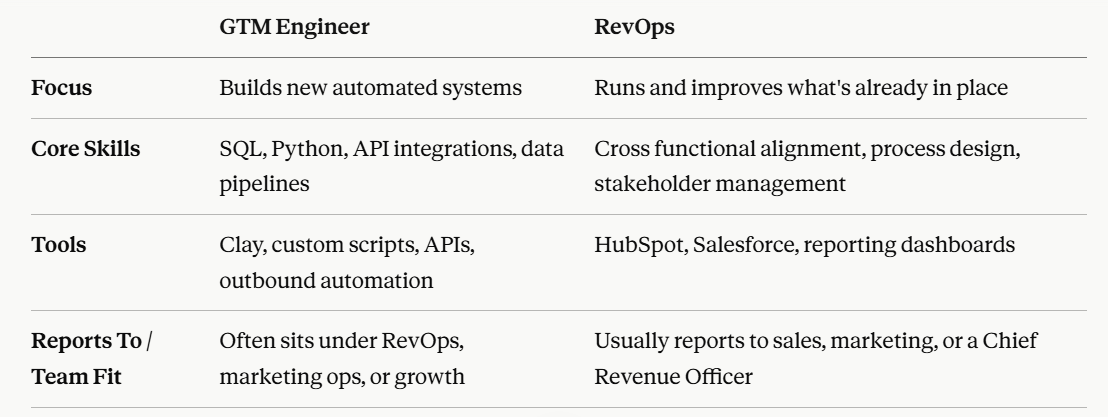
- Understand each role's primary responsibility: GTM Engineers build automated systems, workflows, and integrations, while RevOps manages CRM governance, reporting, process optimization, and cross-functional alignment.
- Match hiring decisions to your biggest challenge: Hire a GTM Engineer when automation and system building are slowing growth. Hire RevOps when inconsistent data, disconnected teams, or unreliable reporting are creating operational problems.
- Build a scalable revenue infrastructure: Use GTM Engineering to automate lead enrichment, buyer signals, outbound workflows, and integrations, while RevOps ensures those systems produce accurate, reliable data across the business.
- Maintain a strong operational foundation: Establish consistent lifecycle stages, reporting, data governance, and revenue processes before scaling automation across your go-to-market organization.
- Recognize when one person can handle both roles: Early-stage companies may benefit from a hybrid GTM Engineer and RevOps professional, but growing organizations typically need dedicated ownership for each function.
- Scale intentionally as complexity grows: As your tech stack, data volume, and GTM motions expand, separating GTM Engineering and RevOps allows both automation and operational excellence to continue improving.
Frequently Asked Questions About GTM Engineering vs. RevOps
What is the difference between GTM engineering and RevOps?
GTM engineering focuses on building technical systems that automate go-to-market work using tools like Clay, APIs, SQL, Python, and workflow automation. RevOps focuses on optimizing existing revenue processes, maintaining CRM data quality, aligning sales, marketing, and customer success, and ensuring teams operate from a single source of truth.
When should a company hire a GTM engineer?
Companies should hire a GTM engineer when they have identified automation opportunities but lack the technical expertise to build them. Common projects include lead enrichment, outbound automation, API integrations, workflow orchestration, and connecting multiple GTM tools into a scalable system.
When should a company hire a RevOps professional?
A RevOps professional becomes valuable when revenue teams struggle with inconsistent reporting, poor CRM data quality, disconnected processes, or misalignment between sales, marketing, and customer success. RevOps creates standardized processes and ensures the entire revenue organization operates efficiently.
Can one person handle both GTM engineering and RevOps?
Yes, especially in early-stage companies where a single person may own both operational strategy and technical automation. As organizations grow, however, the workload typically becomes too large, and companies often separate the roles so GTM engineers can focus on building systems while RevOps focuses on optimizing business processes.
Where does Clay fit into GTM engineering?
Clay has become one of the most common platforms used by GTM engineers to automate lead research, enrichment, scoring, and outbound workflows. Rather than manually researching prospects, GTM engineers build automated systems in Clay that continuously enrich data, identify buying signals, and trigger personalized outreach at scale.


-2.png)