-4.png)
Modern B2B prospecting software combines visitor identification, data enrichment, AI research, outreach automation, and CRM integration to help sales teams find and engage qualified buyers faster. Instead of relying on a single platform, leading organizations build connected prospecting stacks that automate the entire lead-to-outreach workflow.
Sales has changed a lot in the last few years.
It used to be that if you just sent a high volume of emails, you’d get plenty of meetings. That strategy worked…until it didn't.

Today’s B2B prospect is much harder to reach. They're used to cold outreach and ignore anything that looks like a template. If a message doesn’t scream “instant value”, they delete it.
On top of that, many teams are using B2B prospecting methods that rely on static lists, manual research, and hours copying and pasting data or guessing email addresses which don’t do anything more than cause teams to miss the best leads.
But there is a solution!
You need software that handles the heavy lifting for you and helps you move away from isolated tools and build a connected stack. This guide will help you do just that as we cover the essential B2B prospecting software you need and how to link these tools together to build a reliable system that finds leads and starts conversations automatically.
Key Takeaways
To update your B2B prospecting methods, you need a stack of tools that automate the entire workflow from research to outreach. Here’s the recommended setup:
- HubSpot: It stores all data and tracks your B2B sales prospect evaluation criteria in one place.
- Vector & Fibbler: These tools reveal which companies are actively visiting your website or engaging with your ads.
- Artisan: Handles every reply, qualifies interested leads, and books meetings on your reps' calendars.
- Common Room: Monitors channels like Slack and GitHub to find B2B prospects who are already discussing your brand.
- Clay: Aggregates data providers to verify email addresses and find hard-to-reach phone numbers.
- Smartlead.ai: Automates high-volume sending and manages mailbox health to ensure high deliverability.
- Octave: Automatically researches leads and writes custom messages, replacing manual template creation.
- OutboundSync: Syncs email activity from your sending tools back into HubSpot to keep your records accurate.

How do you define the right B2B sales prospect evaluation criteria?
A lot of sales teams are making the same mistake right out of the gate: they pick a job title, an industry, a company size, and then they start building a list.
On paper, that sounds fine. But in reality, you’re just hoping (or guessing) that out of those 1,000 people, one of them happens to need your product right now.
And that’s why response rates are usually so low.
To fix this, you need to change your B2B sales prospect evaluation criteria. Instead of asking "who are they," you need to ask "what are they doing?"
The best time to reach out to a B2B prospect is when they’re actively showing interest (intent). If you can see that a company is researching your solution, you don't need to sell them on why they need it, you just need to show them why you’re the right choice.
Here’s how the modern stack helps you capture those signals.

Which B2B prospecting tool identifies anonymous website visitors?
You probably have hundreds of people visiting your website every week who never fill out a form. You know they were there, but you don't know who they were.
This is where Vector comes in.
It’s a B2B prospecting tool that de-anonymizes your traffic, telling you exactly which companies are reading your blog, checking your pricing page, or looking at your case studies.
And when those audiences flow into your ads or outbound sequences, the lift is real as Vector customers have seen 7.8% LinkedIn CTR, 3× lower CPC, 3× higher CTR, and even 17× ROI in just three months.
So instead of cold emailing a stranger, you can reach out to a company that was literally just looking at your product. That turns a cold lead into a warm one instantly.
How can Fibbler improve my B2B prospecting strategies with ad data?
If you run ads on LinkedIn or other platforms, you know that clicks are expensive. But for every person who clicks your ad, there are dozens of others who saw it, read it, and maybe even liked it, but didn't click.
Most teams ignore these people. But Fibbler helps you find them.
It picks up impression-level intent, meaning companies who saw your ads, hovered on them, or interacted lightly without ever visiting your site.
This gives you a new pool of warm accounts who are clearly paying attention but aren’t ready to hit a demo button yet.
And the best part is Fibbler doesn’t just surface that intent, it pipes it straight into your CRM. It syncs LinkedIn ad impressions, clicks, and engagements for 7-, 30-, and 90-day windows, creating nine time-bound fields on the company record. This lets your team score engagement by recency and prioritize accounts that are heating up right now instead of relying on vague ad platform reporting.
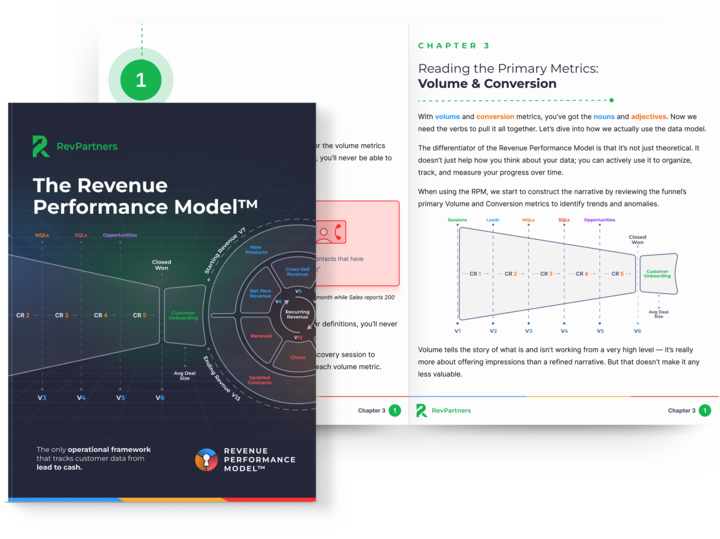
The Revenue Performance Model
Do you want to track the entire revenue journey in your CRM so you can see what's broken, why it happened, and where to fix it?
Download the Revenue Performance Model HERE
How does Common Room help find a B2B prospect in private communities?
Buyers trust other buyers more than they trust salespeople. Because of this, a lot of the decision-making process happens in the "Dark Funnel”, which are places you don’t always have visibility into (e.g. Slack communities, Discord groups, Reddit threads, LinkedIn comments).
Common Room helps you see these signals.
It pulls in activity from public communities and any private groups you’ve connected. It can alert you if a potential B2B prospect joins a community, asks a question, mentions your brand, talks about a competitor, or shows interest in your space.
And the results speak for themselves as companies using Common Room report 30% more meetings per rep, 74% more pipeline in a single quarter, and 40% more meetings in just one month.
Instead of a random, cold email you can offer a solution that actually fits.
Why is data enrichment critical for B2B sales prospecting?
Finding a target company is actually the easy part. The hard part is finding the right person and a working email address.
And nothing kills a campaign faster than bad data. If, for example, you load a list of 500 prospects and 20% of the emails bounce, you risk destroying your sender reputation. If Google or Outlook sees a high bounce rate, they start sending all your future emails straight to the spam folder.
To avoid this, you need B2B prospecting tools that prioritize accuracy over everything else. You can’t rely on a single database anymore, you need a system that checks multiple sources to ensure the data is real.
What makes Clay one of the best tools for B2B prospecting?
Most sales tools rely on one proprietary database. If they don't have the email you need, you’re out of luck.
But Clay works differently.
Check out our latest webinar w/ Clay 👇
It uses waterfall enrichment, checking multiple data providers in sequence, to give you broader coverage and higher accuracy on every record.Instead of relying on just one source. For example, if you were looking for a prospect's phone number, you can configure it to check your preferred provider first, and if they don't have the data, it moves to the next one, and then the next.
And the proof is in the numbers as Clay is trusted by 300,000+ GTM teams and gives you access to 150+ premium data sources.
By pulling from multiple databases, you get broader coverage and a better shot at finding a real, working contact. This makes Clay one of the best tools for B2B prospecting for teams that care about quality data.

Can a B2B sales prospecting tool automate your research?
Finding an email address is important, but it’s not enough. To get a reply, you need context.
Usually, this requires a lot of manual work as you have to comb through job boards, read recent news articles, and analyze the company's website to find a hook. It can take 10 to 15 minutes per lead.
But Clay automates this research process as it creates a digital dossier for every lead instantly. It analyzes publicly available web data, Google results, and open job postings to find the triggers that matter, such as a company hiring for a specific role or a recent funding announcement.
This turns Clay into a powerful B2B sales prospecting tool for personalization. It hands you the relevant details on a silver platter, so you can send a message that looks like you spent hours researching, even though it took seconds.
How do you automate outreach with B2B sales prospecting software?
So, you have the signal, and you have the data. Thanks to the tools we just covered, you know exactly who to target, you have their verified email, and you have a specific reason for reaching out.
Now comes the moment of truth: you actually have to write the email and hit send.
This is where most campaigns fall apart. You either send too few emails to make a difference, or you send too many and end up in the spam folder. Plus, staring at a blank screen trying to turn your research into a catchy message is exhausting.
To fix this, you need B2B sales prospecting software that handles both the heavy lifting of delivery and the creative work of writing.
Why is Smartlead.ai essential for B2B prospecting strategies?
If you send cold emails from your primary Google or Outlook account, you’re playing with fire. If you get flagged as spam, your entire company could lose the ability to email clients or investors.
Smartlead.ai solves this problem by separating your cold outreach from your main business email.
It allows you to create unlimited sender accounts and automatically warms them up, meaning it sends simulated send/receive activity back and forth to build trust with email providers before you ever message a real prospect.
It’s also one of the most widely used cold email tools on the market as 87,000+ businesses rely on it.
When you’re ready to launch, Smartlead manages the volume for you. It ensures your emails land in the primary inbox, not the promotions tab. For any serious B2B prospecting strategy, it’s the only way to scale safely.
Can AI write your B2B sales prospecting emails?
We’ve all used templates before that sound like this: "I saw that you are [Role] at [Company], and would love to chat."
They work okay, but they’re boring. To get a high response rate, every email needs to feel like it was written 100% for that specific person. But you obviously can't spend 20 minutes writing every single note.
Octave bridges this gap.
It’s a B2B prospecting tool that uses AI agents to do the writing for you. It takes the research you gathered (like the data from Clay), crafts a unique message for every single prospect, and actually constructs sentences based on the prospect's industry, news, and role.
You get the volume of an automated campaign with the personal touch of a manual one.

Who works the replies your B2B prospecting software sends?
Every tool up to this point ends at the send button.
But the replies still come back, and this is where a lot of teams stall. Someone has to read each one, work out whether it's a real buyer or a polite no, answer the objection, and find a calendar slot before the interest cools off.
Artisan picks up at this point.
Ava, its AI BDR, handles every reply in a campaign. She qualifies interested leads, answers objections, and books meetings directly on your reps' calendars. You decide when a human takes over by setting escalation rules, and you can run her in approval mode so she drafts each reply and waits for your click before it sends.
She'll run the front half too if you want her to, searching a database of over 250 million verified B2B contacts, enriching them from over 20 data sources, and sending across email and social with call steps queued in the dialer.
And the results back it up as RAISE Summit used Artisan to source $700K in ARR in six months, a 20x return.
How do you keep your B2B prospecting data organized?
You’ve built the perfect list. You’ve written great emails. You hit send.
This is where most teams run into a wall. You have a sending tool that’s firing off thousands of emails, and you have a CRM where your sales team actually lives. The problem is, they’re usually totally disconnected.
Your outreach tool knows that a prospect opened an email three times, but your CRM is blank. This creates a data silo. Your sales reps end up checking three or four different tabs just to figure out if a lead is cold or active. Even worse, they might reach out to someone who is already in a sequence, making the whole company look unorganized.
To fix your B2B prospecting methods, you have to bridge this gap.
Why is HubSpot the best CRM for B2B sales prospecting?
We’ve all heard the rule: "If it isn't in the CRM, it didn't happen." It’s a cliché, but it’s true.
But you might be asking, "Why HubSpot? Why not Salesforce?"
For a modern outbound stack, HubSpot is simply better. While Salesforce is built for complex reporting, HubSpot is built for speed.
First, HubSpot plays nice with the new school tools. Platforms like Clay and Smartlead often build their best integrations for HubSpot first. You can connect this entire stack in an afternoon without hiring a developer or paying a sales ops tax.
Second, HubSpot offers a dedicated "Prospecting Workspace” where your reps can see their tasks, their active leads, and their sequences all on one screen.
By using HubSpot as your central B2B sales prospecting tool, you ensure that every website visit and every cold email is tracked in a system your reps actually like using.
Want more HubSpot help? Check out our HubSpot Training Videos! 👇

How does OutboundSync connect your B2B sales prospecting software?
When you build a modern stack, you’re choosing best-in-class tools. You use Smartlead because it’s incredible at delivering emails at scale, and you use HubSpot because it’s the best place to manage relationships. The goal is to let each tool do what it does best.
OutboundSync is the bridge that connects these two powerful systems.
It works in the background to ensure that your sending engine and your closing engine are always in sync. It automatically maps every interaction from Smartlead (every email sent, every open, every reply) and logs it directly into the correct contact record in HubSpot.
You get great deliverability and clean CRM data at the same time. And because everything syncs into HubSpot automatically, you can finally see which tools are making you money.
What does the perfect B2B prospecting workflow look like?
The days of relying on a single tool to do everything are over. To fix your B2B prospecting methods, you need a team of specialized tools working in unison.
Here’s the complete picture of the modern stack we just built:
- Catch the Signal: Use Vector and Fibbler to see who ‘s on your site and clicking your ads, and Common Room to hear who’s talking about you in private communities.
- Enrich the Data: Use Clay to verify emails and automate the deep research that used to take hours.
- Send the Message: Use Smartlead to handle the volume and deliverability, and Octave to write personalized notes at scale.
- Sync the Results: Use OutboundSync to make sure every interaction lands in HubSpot, keeping your data clean and your sales team happy.
The best tools for B2B prospecting aren't necessarily the ones with the most features or the highest price tags. They’re the ones that talk to each other.
So, take a hard look at your current setup. If you’re still copying and pasting data between tabs, it’s time to upgrade. Start building this connected stack today, and watch how much faster your B2B prospecting moves.
Recap: How to Build a Modern B2B Prospecting Software Stack
To build an effective B2B prospecting system, organizations should focus on:
- Identify buying signals: Use tools like Vector, Fibbler, and Common Room to uncover anonymous website visitors, advertising engagement, and buyer activity across communities and digital channels.
- Enrich prospect data: Use Clay to verify contact information, identify decision-makers, automate company research, and improve CRM data accuracy through waterfall enrichment.
- Personalize outreach: Use AI-powered tools like Octave to transform research into personalized emails that reflect each prospect's business priorities and current context.
- Scale outbound safely: Use dedicated outbound platforms such as Smartlead.ai to manage deliverability, sender reputation, and high-volume email campaigns.
- Centralize customer data: Use HubSpot as the central CRM where prospect activity, engagement history, workflows, and sales processes remain connected.
- Keep systems synchronized: Connect your prospecting tools with platforms like OutboundSync so email activity, buyer engagement, and CRM records stay accurate without manual updates.
-1.png)
-2.png)
-Mar-26-2026-04-53-21-1120-AM.png)