-1.png)
Revenue optimization is the process of increasing revenue and profitability by identifying and removing friction throughout the customer journey. Instead of relying solely on new lead generation, B2B revenue optimization improves conversion rates, sales velocity, customer retention, and expansion revenue to maximize growth from existing demand.
Are more leads the only way to grow?
Well, not if prospects are dropping out of your sales process because of slow emails or confusing pricing.
The most successful businesses have stopped obsessing over the top of the funnel and started focusing on B2B revenue optimization. In fact, organizations with a firmly established RevOps model are 1.4x more likely to exceed revenue targets by 10% or more. They’ve realized that the fastest way to grow is simply to get better at closing the people who are already interested in what they do.
When you optimize revenue, you’re looking for the specific gaps (like a three-day delay in a follow-up or a proposal that’s too complicated to read) that cause a good deal to go cold. By building a consistent revenue optimization cycle, you stop guessing why deals stall and start building a predictable system for closing them.
Key Takeaways
- The Definition: What is revenue optimization? It’s a data-driven system used to identify and fix friction in the customer journey to increase profit without needing more lead volume.
- The Framework: How to execute a revenue optimization cycle by tracking data, finding leaks, testing improvements, and measuring profit gains.
- The Tactics: Practical revenue optimization strategies like fixing sales hand-offs, value-based pricing, and expanding existing customer accounts.
- The Action Plan: A step-by-step checklist to start your B2B revenue optimization process today by auditing lost deals and mapping sales response times.
How the Revenue Optimization Cycle Works
You can build a more predictable business by looking at revenue as a series of connected stages, not one big number.
That means tracking how many prospects and customers reach each stage, how effectively they move to the next one, and where performance starts to break down.
RevPartners uses the Revenue Performance Model (RPM) to create that visibility across the full customer journey. Instead of only asking how to generate more leads, RPM helps answer a more useful question: Where are we losing revenue, and what should we fix first?
A typical B2B revenue journey might look like:
Sessions → Leads → MQLs → SQLs → Opportunities → Closed Won → Revenue → Customers
From there, you can compare both the volume at each stage and the conversion rate between stages to find the biggest opportunities for improvement.
McKinsey data cited in a 2026 B2B metrics report shows companies that effectively use commercial analytics are 1.5x more likely to achieve above-average growth.
To optimize revenue, follow these four stages:
Stage 1: Track Volume and Conversion
Start by measuring two things across your revenue process: how many people reach each stage and what percentage successfully move to the next one.
This matters because more volume doesn't automatically create more revenue.
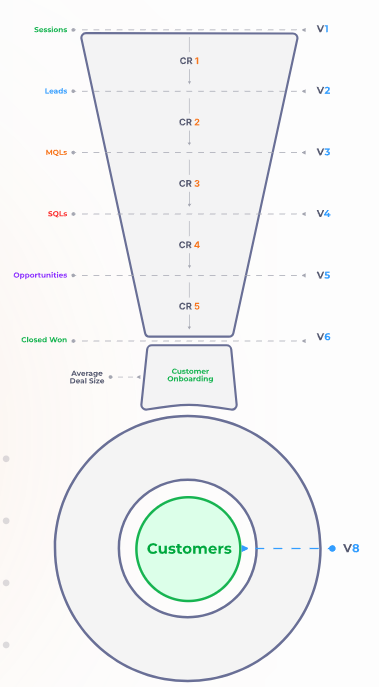
You might generate more leads this quarter but still create fewer opportunities if your lead-to-MQL or SQL-to-opportunity conversion rate drops.
Example: Generating 1,000 leads last quarter and 1,250 this quarter isn't necessarily progress. If a smaller percentage of those leads become qualified opportunities, the extra volume is not actually improving revenue performance.
Before adding more demand, find out where the demand you already have is getting lost.
Stage 2: Find the KPI That Is Breaking Down
Once you can see the full revenue journey, look for the stage where performance starts to fall.
Start with your primary KPIs, including the volume and conversion metrics that show how effectively revenue is moving through your business.
Look for a conversion rate that's declining, a stage where volume suddenly drops, or a KPI that has consistently missed its target.
Then go one level deeper.
If your lead-to-MQL conversion rate is falling, for example, break it down by source, campaign, industry, geography, product, or ICP segment.
That helps you separate where the problem is from why the problem is happening.
Example: Your overall lead-to-MQL conversion rate might look weak, but when you break it down by source, you discover that one paid campaign is dragging down the average. Now you know where to focus instead of rebuilding the entire funnel.
Want to map this across your entire revenue engine? See how to track volume, conversion, and the KPIs that show where revenue is breaking down. 👇
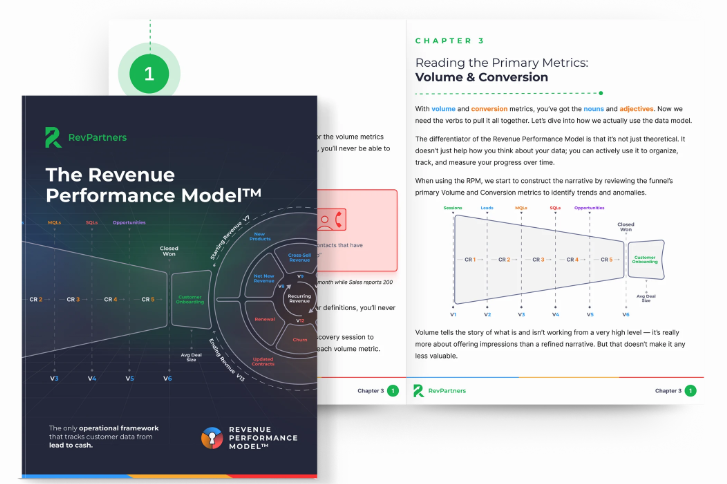
Stage 3: Test a Specific Fix
Once you know which KPI is underperforming and why, change one part of the process that directly affects it. Small, targeted adjustments are easier to measure than broad changes across the entire revenue engine.
Example: If your opportunity-to-closed-won conversion rate drops after security review, create a Security Fact Sheet that answers common questions upfront. Send it earlier in the process and measure whether more opportunities continue moving forward.
Stage 4: Measure the Revenue Impact
After making the change, go back to the KPI you were trying to improve.
Did the conversion rate increase? Did more prospects reach the next stage? Did revenue improve downstream? Did the sales cycle get shorter?
The goal isn't simply to prove that the new process is faster. You need to know whether it improved revenue performance.
Example: If your opportunity-to-closed-won conversion rate increased after changing the security review process, keep following those deals downstream. If more of them become customers and revenue improves, you've found an optimization worth keeping.
Then repeat the cycle with the next constraint.
Stop guessing where growth is stuck. Take the RPX Revenue Performance Modeling course and learn how to find it, fix it, and measure the impact. 👇
.png?width=1600&height=800&name=RPX%20Cert%20Meta%20Image%20-%20RPM%20(1).png)
Top B2B Revenue Optimization Strategies for 2026
To keep the momentum going, once you have the cycle in place, you can apply it to specific areas of your business. In 2026, the most effective B2B revenue optimization happens by moving the people you already have through your system with less effort.
Align Your Marketing and Sales Hand-off
Successful revenue cycle optimization depends entirely on the hand-off, the moment a lead moves from a marketing interest to a sales conversation. If there’s a delay or a lack of context here, the lead goes cold immediately. In fact, B2B organizations with tightly aligned sales and marketing operations achieve 24% faster three-year revenue growth and 27% faster three-year profit growth.
You can fix this by setting a strict speed-to-lead standard where every qualified prospect receives a personalized scheduling link or a human response in under an hour. By prioritizing this speed, you stop losing high-quality leads to competitors who simply reacted faster.
Focus on Expansion Revenue
For recurring-revenue businesses, optimization doesn't stop when a deal closes.
You also need to understand what happens to revenue after someone becomes a customer.
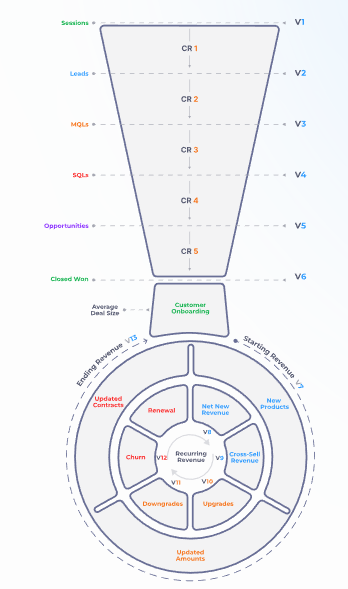
A simple way to look at it is:
Starting Recurring Revenue + Cross-Sells + Upgrades − Downgrades − Churn = Ending Recurring Revenue
If cross-sells and upgrades outweigh downgrades and churn, your existing customer base is generating growth. If churn and contraction are winning, adding more new customers may simply be masking a retention problem.
This is why Net Revenue Retention (NRR) matters so much for recurring-revenue businesses. It shows whether the customers you already have are becoming more or less valuable over time.
Instead of treating renewals, upsells, downgrades, and churn as separate metrics, look at them together to understand whether your post-sale revenue engine is actually growing.
If you’re serious about revenue optimization, you can’t ignore retention.
This session walks through how to track MRR, ARR, churn, and NRR inside HubSpot and how revenue categories impact real growth. 👇
Increase Your Sales Velocity
Sales velocity measures how fast a deal moves through your funnel and how much it’s actually worth. You can use B2B revenue optimization tactics to audit your meetings and remove any step that doesn’t add direct value to the buyer.
If your current sales cycle requires four meetings but could be handled in two, you’re artificially slowing down your revenue. Removing the extra meetings allows your team to close more deals in less time without needing to increase your headcount.
Maintain Pricing Integrity
You can often optimize revenue without gaining a single new customer by aligning your price with the actual value you provide. This requires a commitment to stop offering deep discounts just to win a deal.
When a prospect asks for a lower price, you should remove specific features or services from the scope rather than dropping the price for the same amount of work. This protects your margins and ensures you’re working with clients who value your expertise.
High-Impact B2B Revenue Optimization Checklist
You don’t need to overhaul your entire business to see results. Use this checklist to run a diagnostic on your current B2B revenue optimization process and find the quick wins that are sitting right in front of you.
[ ] Map Your Revenue Performance
Before changing your process, make sure you can actually see how revenue moves through it.
Map the major stages of your customer journey and identify the volume and conversion metrics between them.
Ask:
- How many prospects reach each stage?
- What percentage move to the next stage?
- Which conversion rates are improving or declining?
- Can you report on those metrics accurately inside your CRM?
If you can't answer those questions, your first revenue optimization project should be fixing your measurement.
The Goal: Know exactly where revenue is being created, lost, or delayed before deciding what to optimize.
[ ] Audit Your Lead Response Time
In B2B sales, speed is a competitive advantage. If a prospect reaches out and doesn't hear back for an hour, they’ve already moved on to your competitor’s website.
Even if a sales rep can’t jump on a call immediately, an automated but personalized "next steps" email can maintain momentum. Reducing your response time is the fastest way to increase your lead-to-meeting conversion rates
The Goal: Are you responding in under 5 minutes?
[ ] Review Your Churn Data
Profitability is about customer retention. If you notice a pattern of clients leaving before their second year, you have a friction point in your post-sale journey.
Fixing churn is the ultimate revenue cycle optimization move. It stabilizes your cash flow and ensures you aren't constantly trying to out-earn a high turnover rate.
The Goal: Identify why customers are dropping off. Is it a lack of onboarding, or a perceived lack of value after the initial implementation?
[ ] Check Your Pricing Tiers
Pricing is the most powerful lever in your revenue optimization strategies. If your prices haven't changed in the last two years, they likely don't reflect the 2026 market value or the increased ROI you provide.
Move away from "cost-plus" pricing and toward value-based pricing. Small adjustments to your tiers can lead to a massive increase in profit margins without requiring a single new lead.
The Goal: Ensure your tiers align with the actual value delivered to the client.
This HubSpot lesson walks through how to structure stages, control automation, and monitor time-in-stage so retention metrics actually mean something. 👇
.png?width=1422&height=797&name=shadab%20academy%20main%20(1).png)
[ ] Assess Your Revenue Tech Stack
Your CRM and sales tools should be active participants in your growth.
If your tech doesn't automatically flag stalled deals or track your sales velocity, it’s holding you back. Your stack should provide the data needed to make informed, data-driven decisions at every stage of the cycle.
The Goal: Does your software help you optimize revenue, or is it just a glorified filing cabinet?
What You Can Start Doing Today
The biggest mistake in B2B revenue optimization is waiting for perfect data before making a move. You can begin improving your sales velocity and profit margins by following this 7-day plan.
Immediate Action: The Post-Mortem Audit
Go into your CRM and analyze your last 10 lost deals. Look past the generic "lost to competitor" or "price too high" notes. Instead, look for the drop-off point.
Find the common stage where the conversation went cold. Was it after the first demo? After the proposal was sent?
The Result: Identifying this specific bottleneck tells you exactly where your revenue optimization cycle needs to start.
The 24-Hour Goal: Automate a Single Friction Point
Identify one manual, repetitive task that slows down your momentum. This is often the busy work that keeps a sales rep from following up with a lead.
Automate it. Whether it’s using a tool like Calendly to remove the back-and-forth of scheduling or setting up an automated "Welcome" email that delivers a case study instantly.
The Result: This small move increases your speed-to-lead and ensures that your prospects never have to wait on a human to find a free minute.
The 7-Day Goal: Conduct "Value Interviews"
Reach out to three of your happiest, most successful customers. Ask them one specific question: "What was the exact moment you realized our solution was worth the investment?"
The Result: Use this data to refine your revenue optimization strategies. If all three customers mention the same feature or result, move that information to the very front of your sales pitch and your proposals to close future deals faster.
Recap: How to Improve Revenue Optimization
An effective revenue optimization strategy should include:
- Map your revenue performance: Track volume at each major customer-journey stage and the conversion rate between stages so you can see exactly where revenue performance starts to break down.
- Diagnose before you optimize: Start with the underperforming KPI, then break it down by source, campaign, ICP, product, geography, or another relevant dimension to understand why it is happening.
- Test targeted improvements: Focus on solving one bottleneck at a time, then measure how each change impacts conversion rates, sales cycle length, and profitability.
- Improve sales and marketing alignment: Create faster lead handoffs, shared definitions, and consistent processes so qualified prospects receive timely follow-up.
- Increase customer value: Prioritize customer retention, renewals, expansions, and upsells to grow revenue from existing accounts while reducing churn.
- Continuously optimize performance: Regularly review CRM data, sales processes, pricing, customer feedback, and revenue metrics to identify new opportunities for improvement.
FAQ: Common Questions on How to Optimize Revenue
These are the most common questions B2B leaders ask when they begin to shift from a lead-gen-only mindset to a focus on revenue cycle optimization.
What is revenue optimization in simple terms?
It's the science of making sure your business doesn't leave money on the table; it’s an approach used to find and fix the specific points where prospects get stuck, confused, or ignored. Instead of just trying to get more of everything, it focuses on getting the most value out of the leads and customers you already have.
How do I start a revenue optimization cycle?
Don't try to fix every stage of your funnel at once. Start by picking one high-impact metric, like your demo-to-close ratio, and finding one small change to improve it by 2%. Once that fix is proven to work, move to the next bottleneck. Continuous, small improvements are what lead to massive compounding revenue gains.
Is B2B revenue optimization different from sales?
Yes. While they work together, they have different roles. Sales is the individual transaction, the conversation and the closing of a deal. B2B revenue optimization is the entire system and infrastructure that supports the transaction.
Why is revenue cycle optimization important right now?
It’s critical because the cost of acquiring new leads (CAC) is constantly rising. If you only focus on the top of the funnel, your profit margins will eventually shrink. Revenue cycle optimization ensures your business stays profitable and scalable even when marketing becomes more expensive, by maximizing the ROI of every lead you generate.
-3.png)

.png)