.png)
HubSpot onboarding helps teams get started with the platform, but implementation goes much further by building the CRM architecture, automation, reporting, and processes that support long-term growth. Understanding the difference helps businesses choose the right level of support and maximize their HubSpot investment.
Key Takeaways
- HubSpot onboarding focuses on platform adoption, while HubSpot implementation includes CRM strategy, automation, integrations, reporting, and long-term scalability.
- Standard HubSpot onboarding works well for simple deployments, but growing organizations often need a HubSpot implementation partner to customize the platform around their business.
- A successful implementation should include data migration, lifecycle stages, pipeline design, lead routing, dashboards, user training, and adoption planning.
- RevPartners offers implementation packages for Sales Hub, Marketing Hub, Service Hub, and enterprise organizations with timelines ranging from 14 to 30 days.
- Choosing the right HubSpot implementation partner can reduce implementation risk, improve user adoption, and accelerate time to value.
What is HubSpot Onboarding?
HubSpot onboarding helps you get your CRM up and running so your team can start using the platform with confidence.

Whether you're implementing Sales Hub, Marketing Hub, or Service Hub, onboarding provides the foundation by configuring your account, introducing your team to the platform, and helping you launch your first sales, marketing, or customer service processes.
Most HubSpot onboarding engagements include:
- Initial account setup
- Basic CRM configuration
- User onboarding and permissions
- Product training
- Best practices for using HubSpot
- Guidance from HubSpot or a certified HubSpot implementation partner
The goal is to help your team get comfortable using HubSpot and answer the questions every new customer has:
- How should we organize our CRM?
- How do we manage contacts, companies, and deals?
- What should our sales pipeline look like?
- Which HubSpot tools should we start using first?
- How do we get value from Sales Hub, Marketing Hub, or Service Hub?
HubSpot Onboarding vs. HubSpot Implementation
The biggest difference comes down to getting started versus building for long-term growth.
HubSpot onboarding helps you launch the platform, while a HubSpot implementation builds the CRM your business will rely on every day.
For some companies, those are almost the same thing. For others, they're completely different projects.
If your business has a straightforward sales process and few technical requirements, onboarding may be enough. But if you're migrating from another CRM, managing multiple teams, connecting third-party systems, or building a scalable revenue engine, implementation becomes much more involved.
A HubSpot implementation starts by understanding how your business operates. From there, your CRM is configured to support your sales process, marketing strategy, customer journey, and reporting needs. That can include designing your CRM architecture, migrating historical data, building lifecycle stages, automating lead routing, creating dashboards, connecting integrations, and standardizing the processes your teams follow every day.
|
HubSpot Onboarding |
HubSpot Implementation |
|
Learn how to use HubSpot |
Build a CRM around your business |
|
Configure the basics |
Design your CRM architecture |
|
Product training |
Align HubSpot with your revenue strategy |
|
Initial setup |
Build automation and reporting |
|
Standard guidance |
Customize HubSpot for your teams and processes |
What Does HubSpot's Direct Onboarding Include?
HubSpot's direct onboarding is designed to help new customers launch the platform successfully. The focus is on getting your account configured correctly, introducing your team to the product, and making sure you understand how to use the core features included with your HubSpot subscription.
While the exact scope depends on the Hub and subscription level you purchase, most onboarding engagements include:
- Guided product walkthroughs
- Initial account and CRM configuration
- Best practice recommendations
- Basic reporting setup
- User training and education
- Dedicated time for questions and answers
The experience is designed to help your team become comfortable using HubSpot and establish a solid foundation for managing sales, marketing, or customer service.
For many businesses, that's exactly what's needed.
HubSpot's onboarding is often a good fit if you:
- Are implementing a CRM for the first time
- Have a straightforward sales, marketing, or service process
- Have few integrations or technical requirements
- Plan to manage your HubSpot portal internally after launch
- Have an internal CRM administrator who can continue building and maintaining the platform
For organizations with more complex requirements, onboarding may only be one part of the project. Businesses migrating from another CRM, supporting multiple teams, building advanced automation, or connecting HubSpot with other business systems often require additional implementation work to ensure the platform is configured around their unique processes and long-term growth goals.
When Does Your Business Need More Than Standard Onboarding?
Standard onboarding is a great way to launch HubSpot, but it isn't designed for every situation.
Research estimates that 55% to 70% of CRM implementations fail, with the biggest challenges stemming from poor user adoption and change management rather than the technology itself. That's why growing organizations often need more than basic product training. They need a CRM built around their processes, backed by a strategy for long-term adoption.

Applied Ceramics is a good example.
Although the company had been using HubSpot for years, lead tracking still lived in spreadsheets, reporting wasn't trusted, and sales had low CRM adoption.
RevPartners helped redesign the CRM around their actual sales process, giving the team reliable reporting, lifecycle stages, and a shared GTM operating rhythm.
Check out the full case study!
A full HubSpot implementation is often the better choice if you:
- Are migrating from Salesforce or another CRM
Check out our video series on how to migrate from Marketo to HubSpot 👇
- Need to implement multiple Hubs across your business
- Manage multiple sales pipelines or business units
- Want Marketing and Sales working from the same data and processes
- Need Customer Success workflows, ticketing, or onboarding automation
- Want executive dashboards, forecasting, and revenue reporting
- Need reliable marketing attribution and campaign reporting
- Have third-party systems that need to integrate with HubSpot
- Are dealing with duplicate records, inconsistent data, or an outdated CRM
These projects require designing a CRM that reflects how your business operates today and can support where it's headed next.
That's why many growing companies choose to work with a HubSpot implementation partner. Instead of stopping at basic setup, an implementation partner helps build the processes, automation, reporting, integrations, and data structure needed to turn HubSpot into a system your entire business can rely on.
What Does a HubSpot Implementation Partner Do?
A HubSpot implementation partner does much more than configure software. The goal is to build a CRM that supports the way your business sells, markets, and serves customers.

Build a CRM Around Your Revenue Process
Every implementation starts with understanding your business goals and the customer journey that supports them. That includes mapping your revenue process, defining how teams work together, and designing a CRM architecture that gives Marketing, Sales, and Customer Success a shared view of every customer.
Check out more info on the revenue mapping process 👇
Configure HubSpot to Match Your Business
No two businesses operate the same way, so no two HubSpot implementations should either. A partner configures custom properties, objects, pipelines, permissions, and automation that reflect your processes instead of forcing your team to adapt to a generic CRM setup.
Migrate and Organize Your Data
Moving to HubSpot often means bringing years of customer information with you. A HubSpot implementation partner helps migrate contacts, companies, deals, and historical activity while cleaning duplicate records, validating data, and creating a stronger foundation for reporting and automation.
Connect the Rest of Your Tech Stack
For many organizations, HubSpot is one piece of a much larger tech ecosystem. An implementation partner helps connect HubSpot with ERP systems, finance platforms, CPQ software, sales tools, marketing platforms, and other business applications so data flows between systems without manual work. When native integrations aren't available, custom API integrations can help bridge the gap.
Build Reporting You Can Trust
One of the biggest reasons companies invest in a HubSpot implementation is better visibility. A well-designed CRM makes it easier to understand what's driving growth through executive dashboards, sales reporting, marketing attribution, customer service metrics, and revenue KPIs. Instead of pulling data from multiple systems, leadership has one place to measure performance and make decisions.
Drive Long-Term Adoption
Even the best CRM won't deliver results if no one uses it. A successful implementation includes administrator training, end-user training, documentation, and ongoing support so your team feels confident using HubSpot every day.
That investment pays off. According to HubSpot's 2025 ROI Report, 92% of customers report high adoption across their organization, and 93% say they use HubSpot daily. Those results don't happen by accident. They come from building a CRM that fits the way teams actually work and supporting users long after launch.
Many businesses also continue optimizing their CRM after implementation as new goals, processes, and growth opportunities emerge.
RevPartners HubSpot Implementation Services
Every HubSpot implementation has different requirements because every business has different goals.
Some organizations need a better way to manage their sales pipeline. Others want to improve marketing attribution, create a more consistent customer onboarding process, or migrate from another CRM.
RevPartners offers implementation services across Sales Hub, Marketing Hub, Service Hub, and custom enterprise projects, allowing you to choose the engagement that best fits your business while building a CRM designed to support long-term growth.

For example, RevPartners helped vcfo migrate its sales processes into HubSpot while creating a unified marketing-to-sales pipeline, standardized lead management, and automated reporting, demonstrating how implementation goes far beyond software setup.
Check out the full case study!
Sales Hub Implementation
A successful Sales Hub implementation creates a repeatable sales process that improves visibility, forecasting, and rep productivity.
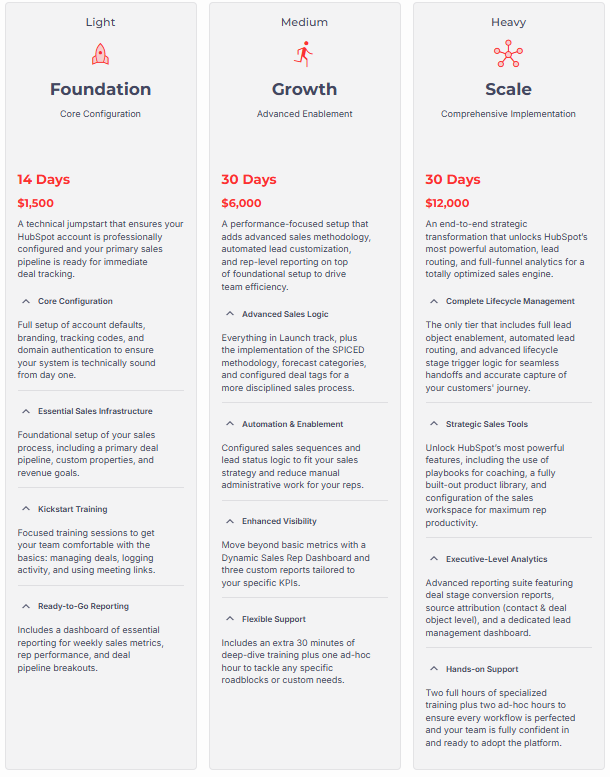
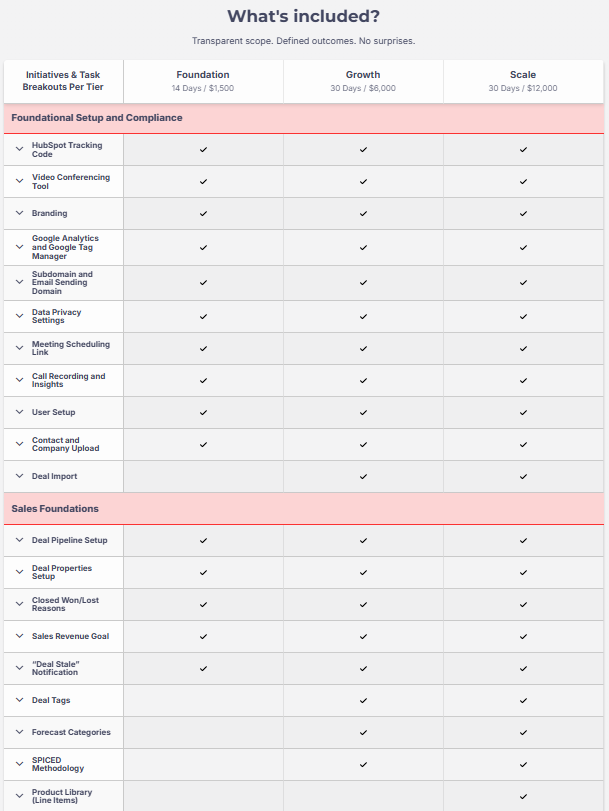
Every engagement begins by building the foundation, including account configuration, user setup, contact and deal imports, and a primary sales pipeline tailored to your process. From there, we configure the automation, reporting, and sales enablement tools that help your team qualify opportunities consistently, reduce administrative work, and give leadership a more accurate view of pipeline performance. Every implementation also includes administrator and end-user training to support long-term adoption.
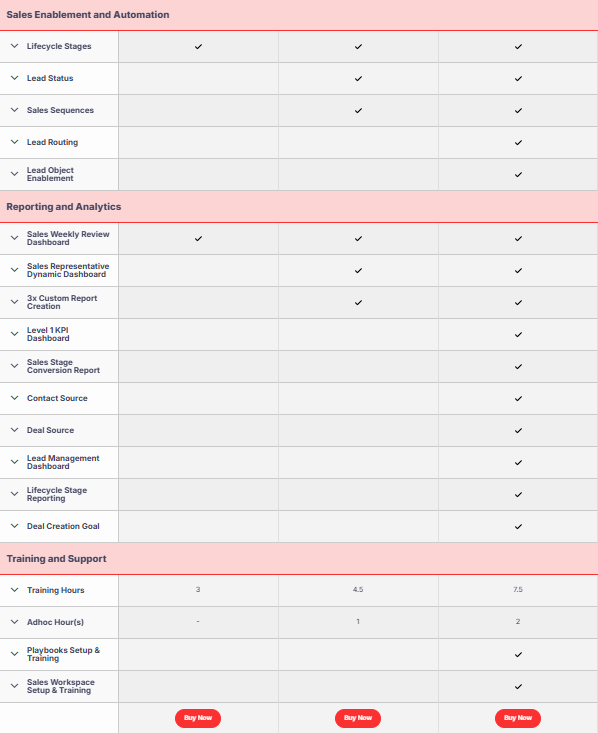
Depending on your business needs, your Sales Hub implementation can include:
- Deal pipelines, custom properties, and revenue goals
- Closed won and closed lost reasons
- Forecast categories and deal tags
- SPICED sales methodology
- Lifecycle stages and lead status automation
- Sales sequences and automated lead routing
- Lead object enablement
- Product libraries, Sales Workspace, and playbooks
- Sales Weekly Review Dashboards, rep dashboards, KPI dashboards, lifecycle reporting, deal stage conversion reports, and source attribution reporting
Whether you choose the Foundation, Growth, or Scale implementation path, the goal is to build a Sales Hub that supports your sales process today while giving your team the visibility and structure to scale tomorrow.
Marketing Hub Implementation
Marketing Hub should help your team do more than launch campaigns. It should help you understand what's driving pipeline and revenue.
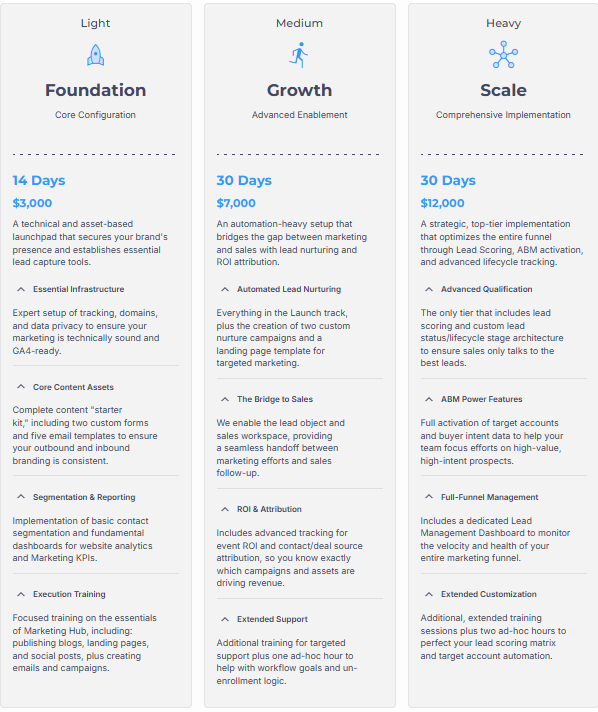
We start by configuring the technical foundation, then build the assets, automation, and reporting needed to connect Marketing and Sales. As your marketing strategy evolves, we implement lead management, attribution, and account-based marketing capabilities that make it easier to prioritize the right prospects and measure the impact of every campaign. Administrator and user training are included throughout the implementation so your team can confidently manage the platform after launch.
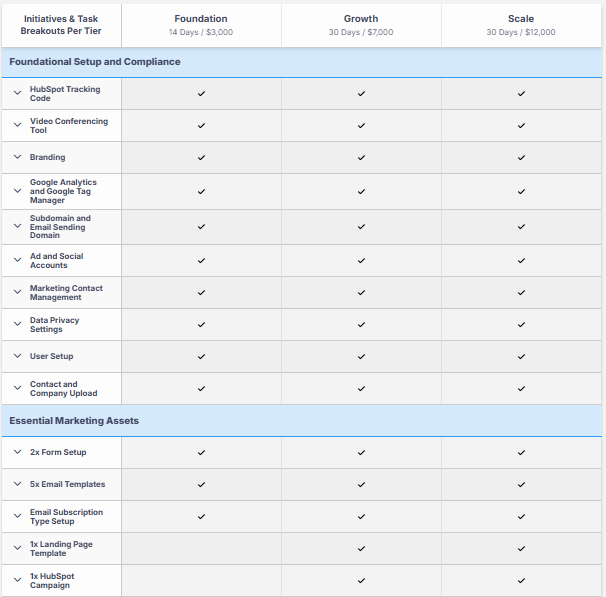
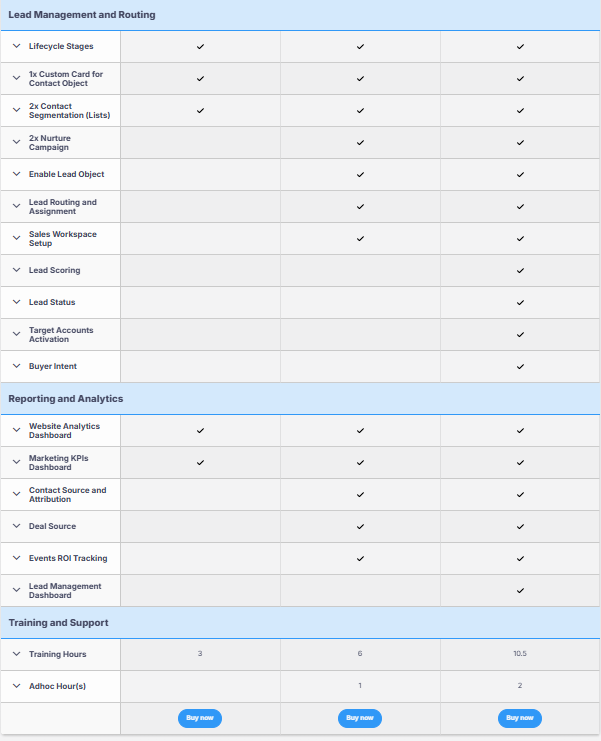
Depending on your business goals, your Marketing Hub implementation can include:
- Tracking codes, branding, domains, and marketing contact management
- Forms, landing pages, email templates, campaigns, and subscription types
- Contact segmentation and nurture campaigns
- Lifecycle stage automation and lead routing
- Lead scoring, Lead object enablement, and Sales Workspace
- Target Accounts and Buyer Intent
- Website Analytics, Marketing KPI, and Lead Management dashboards
- Contact source attribution, deal source attribution, and Events ROI reporting
The result is a Marketing Hub implementation that gives your team the tools to generate demand, automate follow-up, and clearly connect marketing performance to business growth.
Service Hub Implementation
Customer experience doesn't stop when a deal closes. A well-designed Service Hub helps your team deliver a consistent experience from onboarding through ongoing support.
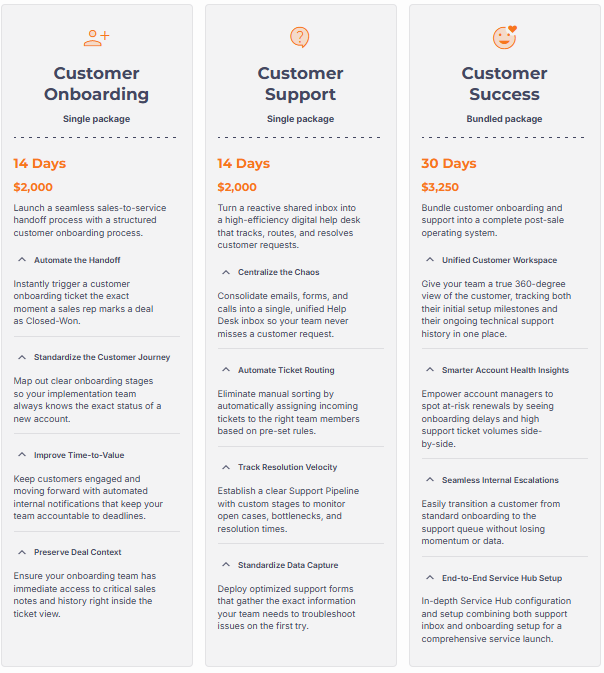
Our Service Hub implementations standardize customer onboarding, support operations, or both by creating structured processes, automating routine tasks, and giving teams clear visibility into customer health and service performance. Throughout the engagement, we configure your system and train your team so they can continue improving it long after implementation is complete.
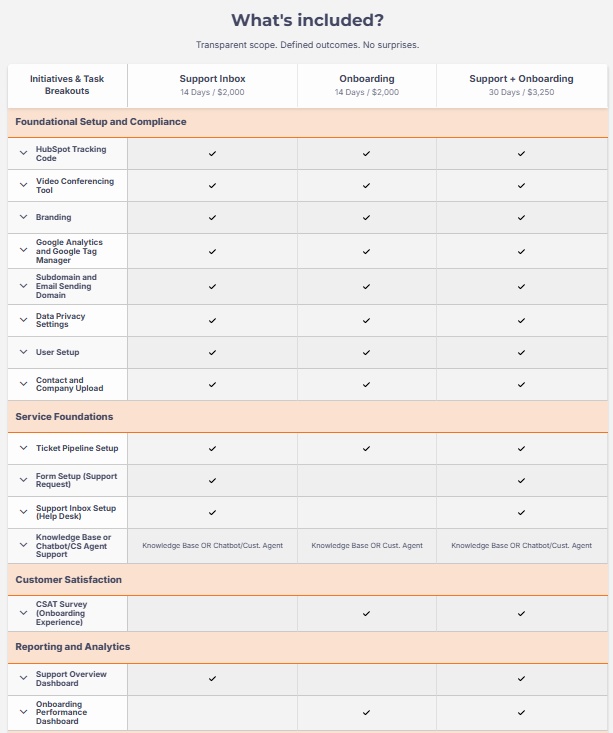
Depending on your customer success strategy, your Service Hub implementation can include:
- Ticket pipelines with custom stages and required fields
- Support request forms, Help Desk, and Support Inbox
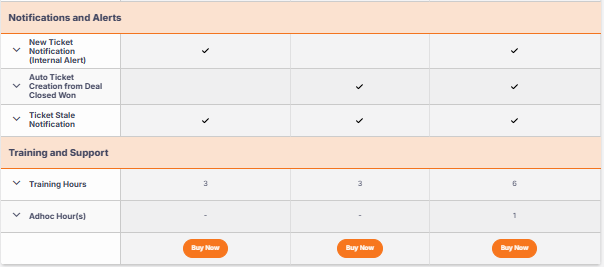
- Automated ticket routing and internal notifications
- Automatic onboarding ticket creation from Closed Won deals
- Knowledge Base, chatbot, or foundational Customer Agent setup
- CSAT surveys
- Support Overview and Onboarding Performance dashboards
- Ticket stale notifications and onboarding automation
Whether your focus is customer onboarding, technical support, or a complete customer success operation, Service Hub provides the structure, automation, and reporting needed to create a better experience after every sale.
Enterprise and Custom Implementations
Not every business fits into a predefined implementation package.
For organizations migrating from Salesforce or another CRM, connecting complex technology stacks, or redesigning their revenue operations, RevPartners develops a custom implementation plan based on your existing systems, business processes, and growth goals. These engagements can include CRM migration, historical data migration, custom integrations, API development, enterprise CRM architecture, and custom statements of work designed around your specific operational requirements.
Instead of forcing your business to adapt to HubSpot, we configure HubSpot to support the way your business operates today while creating a foundation that can grow alongside your organization.
How to Choose the Right HubSpot Implementation Partner
Not every HubSpot implementation partner offers the same level of expertise. Before making a decision, look beyond certifications and ask how each partner approaches strategy, implementation, and long-term success.
Here's what to look for:
- HubSpot expertise. Look for a partner with deep platform knowledge, multiple implementations, and experience across the Hubs you'll be using.
- RevOps experience. A great implementation should improve your revenue process, not just configure your CRM. Choose a partner that understands how Marketing, Sales, and Customer Success work together.
- Industry experience. Every industry has different customer journeys, reporting needs, and operational challenges. Relevant experience can shorten implementation time and reduce risk.
- Migration expertise. If you're moving from Salesforce or another CRM, ask about data migration, field mapping, data cleanup, and how historical records will be preserved.
- Reporting and attribution. Your CRM should help you answer business questions, not just store data. Ask what dashboards, KPI reporting, and attribution reporting are included.
- Automation capabilities. Make sure the partner can build workflows for lead routing, lifecycle management, customer onboarding, and internal notifications that reduce manual work.
- Training and adoption. Even the best implementation fails if your team doesn't use it. Look for admin training, user training, documentation, and post-launch support.
- Scalability. Your CRM should support where your business is going, not just where it is today. Ask how the implementation can evolve as your team, processes, and technology stack grow.
- References and proven results. Case studies, customer references, and implementation experience provide a better picture of what it's like to work with a partner than certifications alone.
Recap: HubSpot Onboarding vs. Hiring an Implementation Partner

To choose the right HubSpot implementation approach, organizations should focus on:
- Understand the difference between onboarding and implementation: Use onboarding to learn the platform and complete basic setup, while implementation builds a CRM tailored to your revenue strategy, customer journey, and business processes.
- Evaluate the complexity of your business: Organizations with CRM migrations, multiple teams, advanced automation, integrations, or sophisticated reporting requirements often benefit from a dedicated implementation partner.
- Build a scalable CRM foundation: Design lifecycle stages, pipelines, automation, lead routing, dashboards, and CRM architecture that support marketing, sales, and customer success across the entire customer lifecycle.
- Prioritize clean data and connected systems: Migrate historical records, eliminate duplicate data, integrate third-party applications, and establish reliable reporting that leadership can trust.
- Invest in user adoption and long-term success: Provide administrator training, end-user enablement, documentation, and ongoing optimization so your CRM continues delivering value as the business grows.
- Select an experienced implementation partner: Look for expertise in HubSpot, RevOps, CRM migrations, reporting, automation, integrations, scalability, and proven implementation results.
Frequently Asked Questions About HubSpot Onboarding and Implementation
What is HubSpot onboarding?
HubSpot onboarding is the process of setting up your HubSpot account so your team can begin using the platform. Depending on your subscription, onboarding typically includes account configuration, user setup, product training, and guidance on HubSpot best practices. It's designed to help teams get started quickly, but it generally doesn't include the custom strategy, automation, reporting, integrations, or CRM architecture that many growing businesses need.
What is HubSpot implementation?
HubSpot implementation is the process of designing, configuring, and optimizing HubSpot around your business processes. In addition to technical setup, implementation can include CRM architecture, sales pipelines, marketing automation, customer onboarding, reporting, integrations, data migration, and user training. The goal isn't simply to launch HubSpot. It's to build a CRM that supports long-term revenue growth.
What's the difference between HubSpot onboarding and implementation?
HubSpot onboarding helps you learn the platform and complete the initial setup. HubSpot implementation goes much further by customizing HubSpot to fit your business. An implementation partner can build custom automation, reporting, integrations, lifecycle stages, lead routing, and revenue processes that aren't typically included in standard onboarding. Every implementation includes onboarding activities, but not every onboarding includes a complete implementation.
Should I hire a HubSpot implementation partner?
If your business has multiple teams using HubSpot, complex sales or marketing processes, CRM migration requirements, or custom reporting needs, working with a HubSpot implementation partner is often worth the investment. An experienced partner can help design your CRM around your revenue process, reduce implementation mistakes, improve user adoption, and create a system that scales as your business grows.
How long does HubSpot implementation take?
The timeline depends on the complexity of your business and the scope of the project. Basic implementations can often be completed in two to four weeks, while more advanced implementations involving multiple Hubs, CRM migrations, custom integrations, or enterprise requirements typically take longer. Many implementation partners also offer phased approaches that allow teams to launch quickly while continuing to expand the platform over time.
How much does HubSpot implementation cost?
HubSpot implementation costs vary based on the Hubs you're implementing, the complexity of your CRM, and the services you need. Basic implementations generally cost less than projects involving custom automation, migrations, integrations, or enterprise CRM design. While cost is important, businesses should also evaluate the experience, methodology, training, and long-term support offered by the implementation partner.
Does HubSpot implementation include data migration?
It can. Many HubSpot implementation partners offer CRM migration services that include importing contacts, companies, deals, activities, custom properties, and historical data from platforms like Salesforce or other CRMs. Some projects also include data cleanup, field mapping, deduplication, and validation to ensure your new HubSpot instance starts with clean, reliable data.
Does HubSpot implementation include training?
Most implementation projects include administrator and end-user training. Training typically covers how to use HubSpot, manage records, build reports, work with automation, and maintain the system after launch. The goal is to improve user adoption so your team can confidently manage HubSpot without relying on outside support for everyday tasks.
Can a HubSpot implementation partner build custom integrations?
Yes. Many implementation partners provide integration services that connect HubSpot with ERP systems, finance platforms, customer support tools, product databases, and other third-party applications. Some partners also offer custom API development when native integrations aren't available, allowing data to flow automatically across your technology stack.
What should I look for in a HubSpot implementation consultant?
Look for a consultant with deep HubSpot expertise, experience in your industry, and a strong understanding of Revenue Operations. They should have experience with CRM migrations, automation, reporting, integrations, and user training, along with a proven implementation methodology and customer references. The best implementation consultants don't just configure HubSpot. They build systems that support your business long after the project is complete.


-1.png)